Allison admits Malaysian ‘Upgrade 18’ made the car worse in some areas

Martin Trenkler
Mercedes started the 2026 season in very strong form. The team was so dominant that some expected it to enjoy several years of supremacy, as it had from 2014 to 2016. However, that advantage gradually ebbed away, and in Brazil neither driver finished on the podium for the first time. Part of the reason is that the major upgrade package the team brought to Malaysia introduced unwanted side effects.
Mercedes won the first six Grands Prix, but has won only one of the last five. The current trend is clearly working against the world champions. The team had hoped to re-establish its advantage in the autumn – or at least recover some of it – but it took the engineers some time to unlock the new upgrade package, and it is clear that it ultimately failed to deliver everything expected of it.
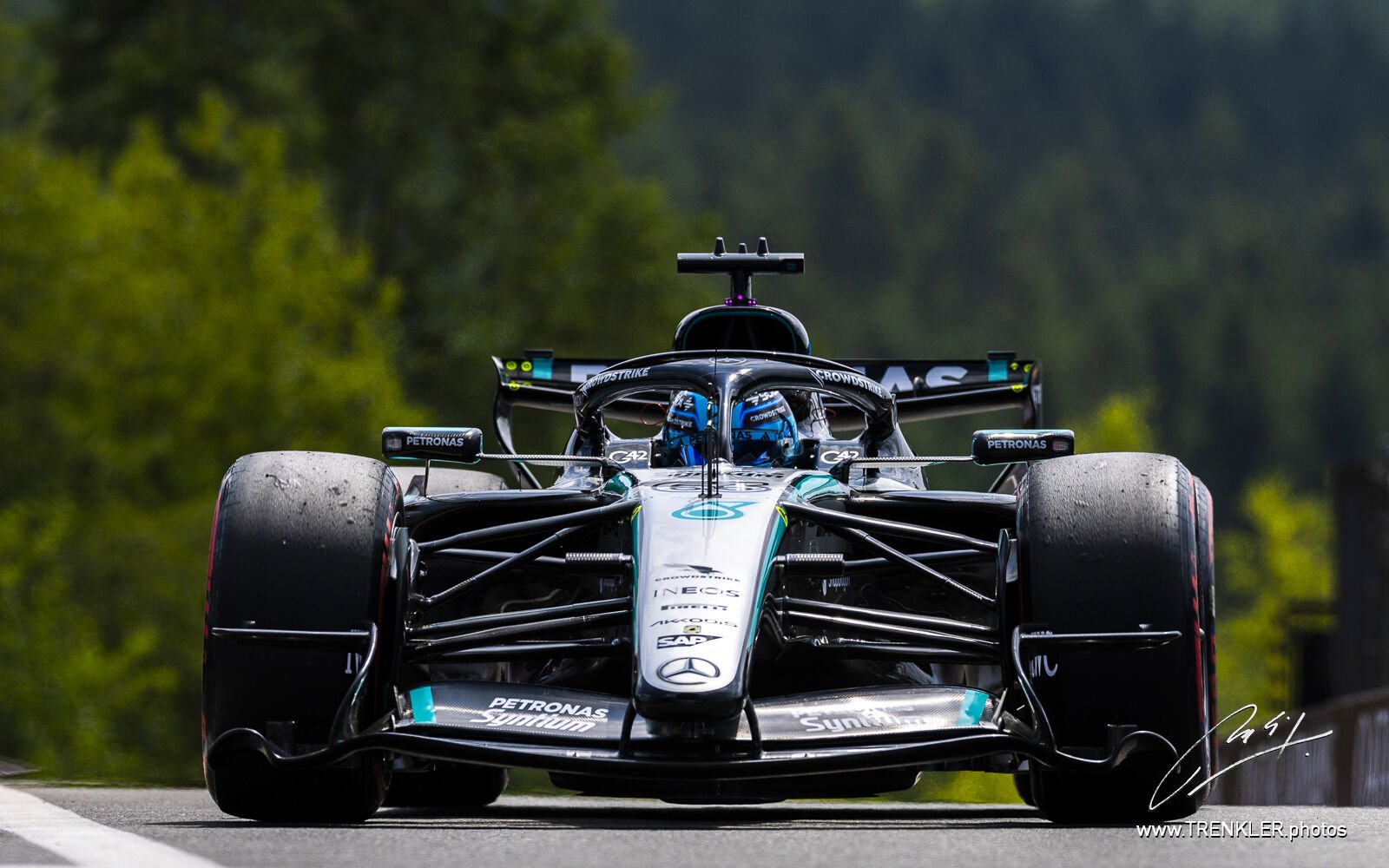
Mercedes certainly took a step forward, but according to the team’s technical director James Allison, it also took a step backwards in areas where it had not expected to. “Our final step of performance, our so-called ‘Update 18’, the thing we brought to the Sepang track and then followed up with the front wing in America… it has given us more downforce, but it has made the car more of a handful,” the British engineer said on the team’s Nu Silver Arrows Radio Show podcast.
“It’s got some areas where it has subtracted a bit of performance that we were not expecting,” Allison admitted.
Mercedes’ early-season advantage has thus gradually disappeared. There are several reasons for that. According to Mercedes’ technical director, the situation has also changed in one particular area that receives little attention. “We were also probably the only car on the weight limit at the start of the year,” Allison said.
“All the folk we were competing with in the championship had a bit of timber to shift, and that was lap time that came to them that wasn’t available to us because we were already skinny and on the limit with the weight,” the accomplished engineer added.
By some estimates, Mercedes held an advantage of eight tenths of a second per lap at the start of the season, which it has since lost. According to Allison, however, that advantage was not just down to weight, aerodynamics or power unit performance, but also optimisation. “Oh, I don’t think you allow others to catch. You can put whatever narrative you like on it, but I think that we started the season super duper strong and we did so for several reasons. I think we were better prepared than many others. I think we had a better handle on the energy management at the start of the year,” Mercedes’ technical director explained.