Formula 1 intends to display drivers’ heart rates from 2027. Verstappen wants no part of it


Getty Images/RB Content Pool
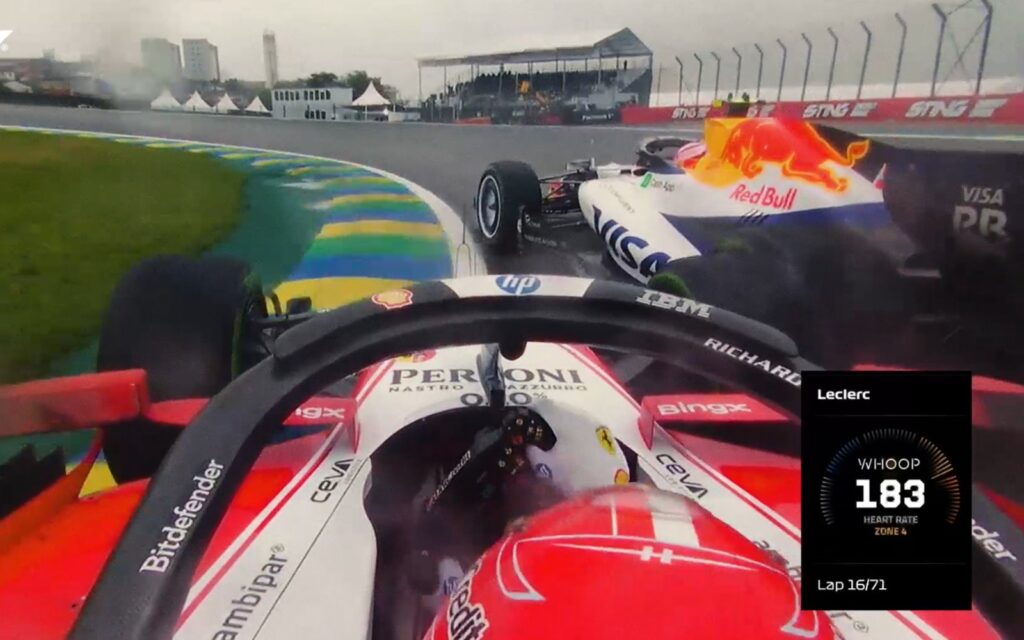
Formula 1 announced a partnership ahead of the Las Vegas weekend with Whoop, which makes smart fitness bands for monitoring recovery, sleep and physical exertion. As part of the partnership, the championship wants to start displaying drivers’ heart rates during live broadcasts. Max Verstappen, however, has already made clear that he will not give his permission.
It is not yet clear exactly how F1 will use the data from the bands, but there are plenty of new possibilities. As well as displaying current heart rates or time spent in different heart rate zones, it could theoretically use Whoop’s metrics to assess drivers’ recovery or physical preparation and compare them with their on-track performance.
For Max Verstappen, however, this is an invasion of privacy. He says he will not give his consent. “I won’t be involved. I don’t use any device. Also, for my training, I don’t use anything because, first of all, I don’t like to be tracked and I know when I’m tired.”
“If drivers want to have that, sure. It’s not something that I like, and also not what I want people to see or show,” the four-time champion said.
Charles Leclerc takes a different view and has no problem sharing his data for this purpose. He already works with Whoop, however, as an ambassador. “I don’t have anything to hide in particular. I’m now an ambassador for Whoop and I’ve been using the device for quite a long time now to track my recovery, my sleep, but also when I’m in the car.”
“And now there’s actually an actual device also that is certified by FIA that we can, without hiding it anymore, wear it while I’m driving, so it’s a good thing. At least for me, it’s very useful, and to show it to everybody is another matter that we’ll for sure discuss, but I personally don’t have any problems with it,” the Monegasque driver insisted.
Russell warns of a distorted picture
There is also the question of what value this data will add to live broadcasts. George Russell warned that the figures from the bands could encourage judgements based on impressions, with viewers trying to compare different drivers using a handful of basic parameters and drawing the wrong conclusions.
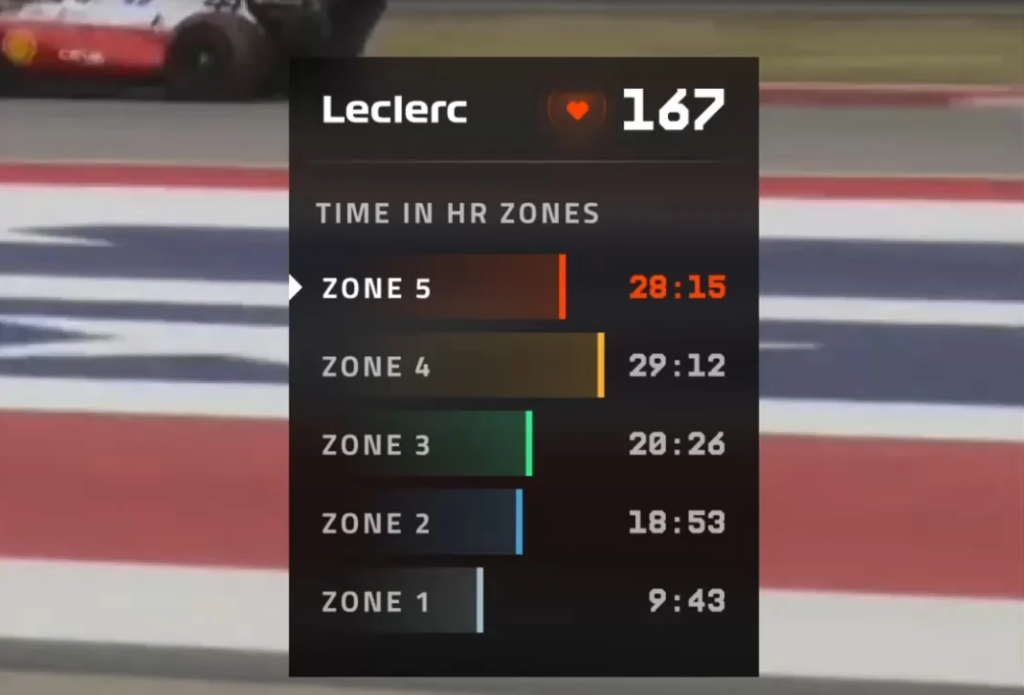
Physiological data is far more complicated to analyse, but there is no time for that during live broadcasts. After all, Formula 1 is already reluctant to explain to viewers what is happening on track. Instead, it goes to great lengths to hide battery and energy recovery data simply to avoid making live broadcasts seem too complicated. If it takes the same approach to heart rates, a distorted picture will be inevitable.
“As a neutral, if I was sat on the sofa, I think I’d really enjoy seeing it,” suggested George Russell, before adding a warning: “But everyone’s different. You’ve got a 45-year-old, his heart rate is probably going to be quite a bit lower than an 18-year-old’s heart rate.”
“And when you’re sat on the grid, you’ll be saying Fernando Alonso’s ice-cool when the lights are going out because his heart rate is much lower. You put my dad in the car, who’s 72, his heart rate’s going to be even lower than Fernando’s,” he said, highlighting the potential absurdity of some of the comparisons that will probably be inevitable. “Even people of the same age have different heart rates as well.”
Users of apps such as Strava will be familiar with this; even two people with similar levels of fitness can have completely different baseline heart rates, making comparisons between them difficult.
“I don’t really know how it could be additive, if that makes sense, because we’re all just so different. But it’s going to create a narrative that’s going to be positive for some, and I’m lucky that I’d say my heart rate’s on the lower side,” Russell revealed.
Fans are therefore likely to see Russell as very calm based on the live broadcast, even though that may not be the case at all. “I would empathise with a driver whose natural heart rate sits 20 beats [per minute] higher than somebody else. So yeah, from a neutral, I think it’s cool. I’m not going to say no, but I think it’s OK as we are,” he added.