
Liam Lawson disqualified as team admits rule breach

Getty Images/RB Content Pool
Liam Lawson need not worry about his penalty for Friday’s collision with Max Verstappen after all. The New Zealander has far more serious problems following qualifying. The FIA has disqualified him from Saturday’s running for a technical breach admitted by the team itself.
From Racing Bulls’ perspective, qualifying had gone perfectly. Liam Lawson finished eighth and Arvid Lindblad ninth, meaning they were simply due to swap positions on the grid once the penalty was applied.
Three hours after qualifying ended, however, Lawson’s smile vanished. On Sunday, he will start from the very back of the grid, behind Valtteri Bottas, who is set to receive a 50-place grid penalty for changing power unit components.
Engines are the stumbling block once again
The disqualification stems from this year’s complicated power unit regulations. Teams have been playing with fire, so to speak, since the spring, when they found a way to circumvent the regulations’ safety requirements to gain a few hundredths of a second. Lawson is the first driver to get burnt.
While drafting the regulations, the FIA gradually came to realise that the cars would not have enough battery energy to draw on the support of the 350 kW (469 bhp) MGU-K at all times. They therefore have to make compromises and forgo its assistance on certain sections of the track.
However, if the power unit were to instantly “switch off” 469 bhp — when the battery ran out, for example — the car would begin slowing at a rate that could pose a danger to the drivers behind.
The FIA therefore included a safety measure in the regulations: if the driver keeps their foot on the throttle throughout, MGU-K power must not decrease by more than 100 kW per second. The software must be set up to keep some energy in reserve in the battery for this protective “ramp-down”.
Every joule of energy must be used as efficiently as possible
There is another article in the regulations which, in plain English, means the following: if a driver lifts off the throttle for any reason, MGU-K power can drop instantly from 350 to 0 kW. That makes sense, for example, on the approach to a corner where braking is required. However, teams have also begun using this “exception” at the end of qualifying laps.
If they followed the original intent of the regulations and reduced MGU-K power by no more than 100 kW per second, the car would not be running at full power for approximately the final three seconds, negatively affecting the lap time.
To extract the absolute maximum from the battery, they lift off the throttle literally a few metres before the finish line and coast through the remainder of the lap. The time lost while coasting is smaller than the gains from having the MGU-K deliver full power throughout the acceleration phase.
But the drivers are taking a considerable risk. If they fail to lift off before the battery runs out, the MGU-K instantly “switches off”. That breaches the rule governing the gradual reduction in power.
That is exactly what happened to Liam Lawson. While his team-mate Arvid Lindblad followed the procedure perfectly, lifting off a few metres before the finish, Lawson left it until after the line. That did not break the rules, but it was inefficient: he was using some of the battery’s energy on his cool-down lap rather than his flying lap.
On his final attempt in Q2, however, he completely forgot, and the battery caught him out. Then came the stewards.
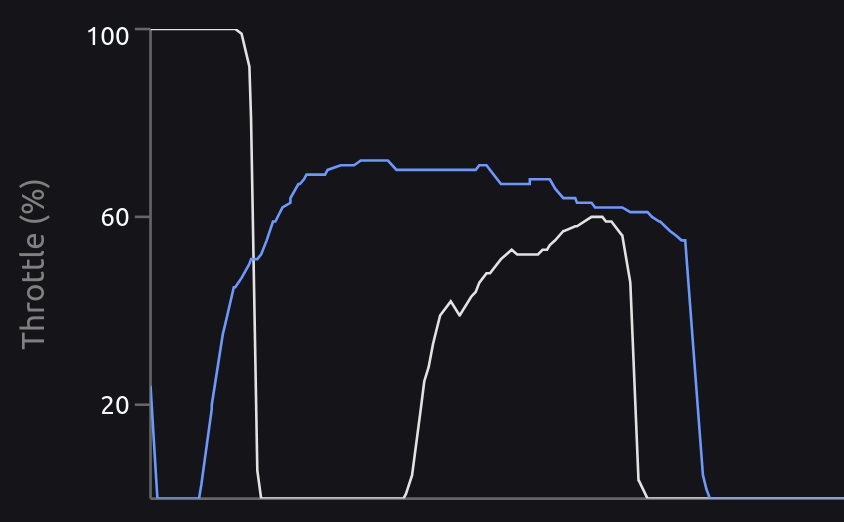
“Evidence submitted, which was accepted by all parties present, showed that after the control line at the end of his fastest lap in Q2, the driver did not lift off the power immediately,” the stewards stated in their verdict. “This resulted in the rate of reduction of MGU-K deployment required to achieve the regulated ‘step down’, not being achieved.”
According to the stewards, Racing Bulls argued in its defence that Lawson had gained no advantage. “Non-compliance with the Technical Regulations is not excused if no performance advantage is gained,” the FIA pointed out. “Further, these regulations require that a car must comply with them at all times during an event.” The “event” also includes cool-down laps.
The stewards ultimately concluded that the extensive body of precedent required them to disqualify Racing Bulls, despite the team having reported the breach itself. The mitigating circumstances in this case were not sufficient for Lawson to avoid disqualification.