27-lap maximum: How will the stint limit work at the Qatar Grand Prix?

© 2018 Adobe Systems, Inc.
Teams will not have the same strategic freedom in Qatar as at other Grands Prix. Pirelli has decided to limit stint lengths for safety reasons, meaning teams will have to count every lap completed. So how exactly will the special rules work, and which laps will count towards the new limit?
Losail presents the biggest challenge of the season for Pirelli’s tyres. Its long, fast corners put extreme loads through the Italian supplier’s rubber, which it says could even compromise tyre integrity. That can be particularly dangerous in high-speed corners because tyre performance and grip do not drop off dramatically once the rubber has worn down. Pirelli therefore wants to prevent drivers from running on tyres with worn-out tread in an attempt to save a pit stop.
As it did last year, Pirelli has therefore imposed a maximum stint length. This time, however, the limit is 27 laps rather than 25. According to Pirelli chief engineer Simone Berra, the increase was possible because this year’s cars have less downforce than last year’s, while the tyre construction is also more robust.
At the same time, the tyre supplier does not want anyone attempting a one-stop strategy on Sunday. With stints limited to 27 laps and the Grand Prix scheduled to run over 57 laps, everyone will be forced to make at least two pit stops.
So which laps will count towards the limit? Strictly speaking, this is not a maximum stint length, but a maximum number of laps completed on any given set. Laps from practice and qualifying will count too.
“Laps will be counted cumulatively across all track sessions, including any laps completed under the Safety Car or Virtual Safety Car,” Pirelli stated in its pre-weekend guidance. “As far as the Grand Prix is concerned, all laps completed from the start signal to the chequered flag will count towards the total. Reconnaissance laps, formation laps and any laps completed after the end of the race will not be included.”
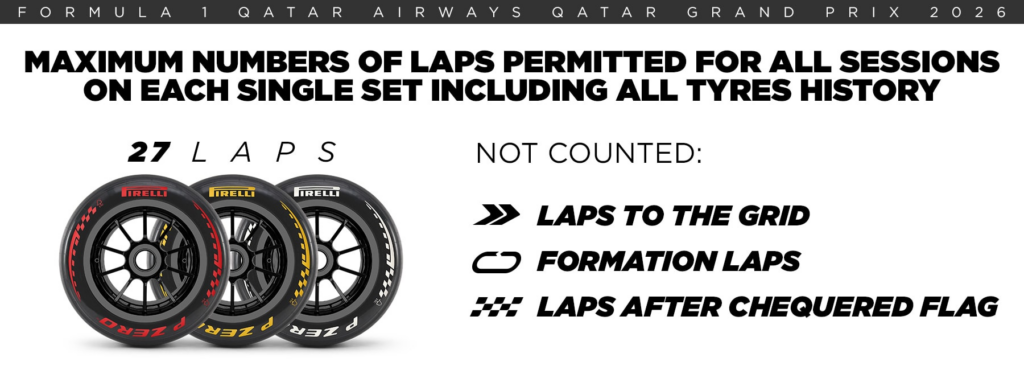
“In all other track sessions, any lap that has been started but not completed will nevertheless be counted as a full lap. Should a team assemble a tyre set using tyres that have covered different mileages, the tyre with the highest lap count will determine the mileage attributed to that set,” Pirelli noted.
Mixing tyres from different sets is normally prohibited on Friday and Saturday. Before the race, however, Article B6.3.3 of the F1 Sporting Regulations allows teams to assemble a set using tyres originally allocated to different sets. This is useful, for example, if a driver flat-spots one tyre but the others are still in good condition. Interestingly, this mixing is also permitted during a standard race weekend.
Pirelli says it will publish an overview of the available tyre sets after qualifying, including the number of laps each has completed. Strategists will therefore already have some insight into their rivals’ tactical options once qualifying is over.