

Overview
Current championship position
- Position
- 4
- Points
- 236
Driver biography: Max Verstappen
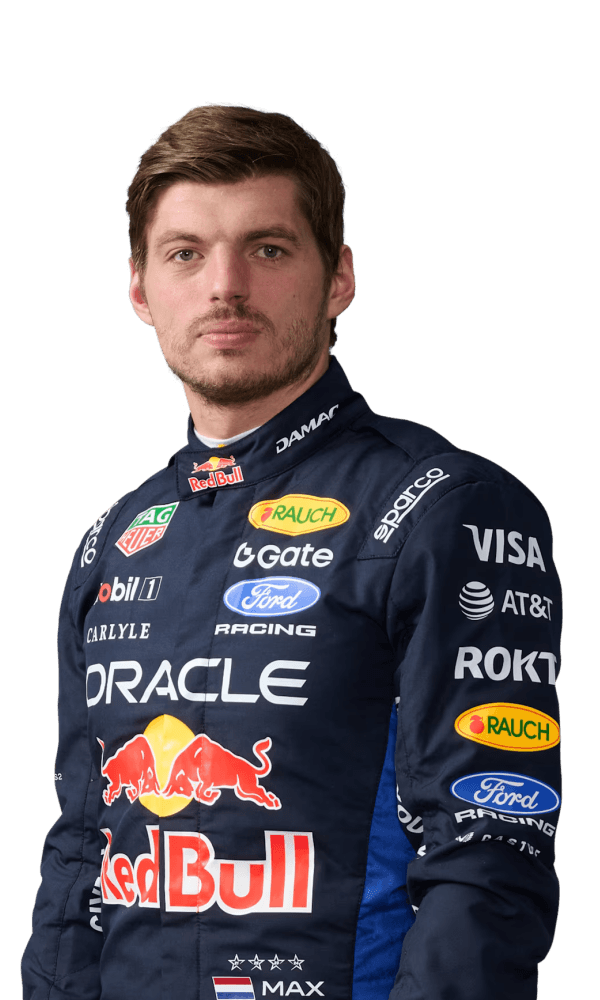
Max Verstappen began gaining racing experience at an age when most of his peers were only just discovering bicycles. He grew up immersed in motorsport, but his surname alone did not guarantee him a place among the elite. Before becoming one of the central figures in modern Formula 1, he went through an exceptionally intensive karting career, a rapid passage through junior single-seaters and a record-breakingly early debut at the pinnacle of motorsport.
A family steeped in motorsport
Max Emilian Verstappen was born on 30 September 1997 in Hasselt, Belgium. Although he was born and raised in Belgium, he represents the Netherlands in motorsport.
Racing was a natural part of family life. His father, Jos Verstappen, contested more than 100 Formula 1 Grands Prix, driving for Benetton, Tyrrell, Stewart and Minardi, among others. Max's mother, Sophie Kumpen, was a successful kart racer who competed at a high international level.
Max was therefore a familiar presence at circuits from early childhood. He began karting at around four years old and was racing regularly by the age of seven. His father Jos played a major role in his development, preparing the equipment, coaching him and analysing his performances.
The results came very early. Verstappen won titles in Belgian and Dutch karting championships before gradually establishing himself among the European and world elite.
Dominance in karting
The most successful period of his karting career came in 2013. Then aged 15, Verstappen produced a string of results that firmly caught the attention of Formula 1's leading junior programmes.
He competed in both direct-drive and gearbox categories, winning several major international titles. He became European champion and capped his final karting season with the world title in the prestigious KZ category.
By the end of the year, it was clear he had outgrown karting. Unlike many future F1 drivers, however, he would not spend several years working his way through a succession of junior single-seater categories.
Verstappen's route was considerably faster.
One season in single-seaters
2014 was his first year in car racing. He gained his initial experience in the Florida Winter Series before entering the FIA Formula 3 European Championship with Van Amersfoort Racing.
Despite facing drivers with far more single-seater experience, Verstappen was immediately able to fight for victories. A run of six consecutive wins across the Spa-Francorchamps and Norisring rounds was particularly striking.
He won ten races in his rookie season and finished third in the European Formula 3 standings. He also won the prestigious Masters of Formula 3 race at Zandvoort.
His performances attracted the attention of Formula 1 teams. Verstappen faced a decision that would fundamentally shape the course of his career.
In August 2014, he joined the Red Bull Junior Team. The programme, led by Helmut Marko, was known for offering the brightest talents a rapid route into Formula 1.
In Verstappen's case, that route was exceptionally short.
In Formula 1 at 17
In October 2014, he was given the opportunity to take part in first practice for the Japanese Grand Prix at Suzuka in a Toro Rosso. He was just 17 years and three days old.
A few months later, he was a full-time Formula 1 driver.
He made his debut for Toro Rosso at the 2015 Australian Grand Prix, aged 17 years and 166 days. That made him the youngest driver ever to start a Formula 1 Grand Prix.
His first season demonstrated not only his speed but also his exceptionally aggressive racing style. He was willing to attempt moves in places where other drivers would not. His best results were two fourth places, in Hungary and the United States.
After just a few months, Red Bull was convinced that Verstappen was ready for its senior team.
Victory on his Red Bull debut
An unexpected switch came ahead of the 2016 Spanish Grand Prix. Verstappen moved from Toro Rosso to Red Bull Racing, swapping seats with Daniil Kvyat.
His very first race with his new team made history.
After the Mercedes cars of Lewis Hamilton and Nico Rosberg collided, Verstappen found himself in the fight for victory. Red Bull chose a two-stop strategy, leaving the young Dutchman to withstand sustained pressure from Ferrari's Kimi Räikkönen over the closing laps.
He avoided a decisive mistake and won.
At 18 years and 228 days old, he became the youngest Grand Prix winner in Formula 1 history. It was also the first victory for a Dutch driver in the F1 world championship.
If Barcelona demonstrated his ability to handle pressure, Interlagos in Brazil later that year showcased his feel for driving in the wet. In an extremely wet race, he dropped back after a late pit stop, but a series of overtaking moves in the closing stages took him from deep in the field to third place.
The 2016 season confirmed beyond doubt that Red Bull had secured a driver capable of fighting for the world championship in the future.
Building towards a title challenge
The following seasons brought further victories, but Red Bull was not yet able to challenge Mercedes consistently across an entire year.
Verstappen won individual Grands Prix while gradually reducing the number of mistakes that had marked his early seasons. In 2017, he won in Malaysia and Mexico, adding victories in Austria and Mexico again the following year.
2019 marked an important phase as Red Bull began using Honda power units. Verstappen secured the first victory for the Red Bull–Honda partnership in Austria, before taking his first Formula 1 pole position at the Hungarian Grand Prix.
He finished third in the championship in both 2019 and 2020. Red Bull was gradually closing the gap to Mercedes, and Verstappen was increasingly emerging as its most serious challenger.
In 2021, that rivalry became a direct fight for the title.
A first title after battling Hamilton
The 2021 season produced one of the most closely followed championship battles in modern Formula 1. Verstappen fought reigning champion Lewis Hamilton for virtually the entire year.
Heading into the final race in Abu Dhabi, the pair were level on points.
The title was ultimately decided on the final lap of the season finale. Following a safety car period, Verstappen had the opportunity to attack Hamilton, passing him to secure both victory and his first world championship.
He ended the season with ten wins, ten pole positions and a record 18 podium finishes.
At the age of 24, he became the Netherlands' first Formula 1 world champion.
Red Bull's record-breaking seasons
His first title was not simply the culmination of one successful season. It marked the beginning of a period of dominance for Verstappen and Red Bull.
He retained the title in 2022, winning 15 Grands Prix during the season. At the time, that set a new Formula 1 record for the most victories in a single campaign.
The 2023 season was even more dominant.
Verstappen won 19 of the 22 Grands Prix to claim his third world title. During the year, he won ten consecutive races, setting another Formula 1 record. He ended the season with 575 points and led more than 1,000 racing laps.
The Red Bull RB19 was among the most successful cars in the championship's history, and Verstappen used its potential to set a series of records that significantly raised the statistical benchmarks of modern Formula 1.
A fourth title without the same dominance
The start of the 2024 season suggested a continuation of the previous year. Verstappen won four of the first five Grands Prix and had seven victories after ten rounds.
Gradually, however, the competitive order shifted. McLaren, Ferrari and Mercedes closed in on Red Bull, and the RB20 no longer enjoyed the same advantage as its predecessor.
That gave his fourth title a different character from the previous two. Verstappen had to defend much of his lead during a period when his team was not the fastest at every circuit.
The São Paulo Grand Prix came to define his season. After a disappointing qualifying session and a penalty, he started down in 17th, but worked his way forwards in wet conditions to win the race.
He sealed his fourth world championship at the Las Vegas Grand Prix.
In doing so, he joined the select group of drivers to have won the Formula 1 world championship at least four times.
Two points short of a fifth title
The 2025 season followed a very different course. McLaren had an exceptionally competitive car, and Verstappen found himself in a much tougher position during the year than he had during Red Bull's most dominant period.
Nevertheless, he remained in title contention until the final race. A strong end to the season significantly reduced his points deficit, and he was still fighting for a fifth consecutive title heading into the Abu Dhabi finale.
He ultimately finished the season second to Lando Norris. Just two points separated them.
Even without the title, it was one of the most impressive seasons of his career, as he remained in the championship fight despite Red Bull not having a clear-cut fastest car for a significant part of the year.
Racing does not stop outside the F1 paddock
Verstappen's relationship with motorsport has long extended beyond Formula 1.
Sim racing is one of his most prominent leisure pursuits. He competes at a high level in virtual racing and was associated with leading sim racing outfit Team Redline for many years. He took part in virtual endurance races, using sim racing not only for enjoyment but also as a way to train and refine his driving skills.
His publicly known interests also include motorbikes, quad bikes and jet skis, but racing itself remains the dominant part of his life outside Formula 1.
He also gradually began developing his own motorsport projects. The Verstappen.com Racing programme was established to bring together activities in real-world motorsport and sim racing, supporting drivers competing in GT racing, among other categories.
One of his ambitions is to create a pathway for leading virtual racers to make the transition from simulators to real racing cars.
Success beyond Formula 1
Verstappen has made no secret of his interest in endurance racing, particularly on the Nürburgring Nordschleife, one of the world's most demanding circuits.
In 2025, he completed the necessary steps on the Nordschleife to obtain a permit to race a GT3 car. Shortly afterwards, he entered his first GT3 race at the circuit.
His debut ended in victory.
Alongside Chris Lulham, he won a four-hour Nürburgring Langstrecken-Serie race in an Emil Frey Racing Ferrari 296 GT3. The result confirmed that his interest in sports cars and endurance machinery was more than an occasional hobby.
Verstappen has also repeatedly spoken of his interest in contesting major endurance races in the future. His long-term activities suggest that a career outside Formula 1 could become an equally compelling part of his motorsport story in the years ahead.
The driver who bypassed the traditional career path
Verstappen's career is unusual in modern motorsport above all for the speed with which he progressed through the ranks.
He finished racing at the highest level of karting in 2013. In 2014, he completed his first season in car racing. By 2015, he was competing in Formula 1, and the following season he won his first Grand Prix.
Five years later, he was world champion.
From a record-breakingly young rookie, he developed into the driver around whom Red Bull built its next championship-winning era. His first title in 2021 was followed by further triumphs in 2022, 2023 and 2024, with the 2023 season in particular ranking statistically among the most dominant individual campaigns in the championship's history.
At the same time, motorsport remains more than simply a professional Formula 1 career for Verstappen. From sim racing and his own racing programme to competing on the Nordschleife, his activities beyond the Grand Prix calendar revolve around the same pursuit he took up as a small child: racing.
That continuity best captures his story so far. Karting, junior single-seaters, Formula 1, virtual racing and GT3 are different disciplines, but in Verstappen's career they form part of a single thread. From his first laps on a kart track to his world championship titles, speed, machinery and competition have remained at the heart of both his professional and personal interests.
Teams raced for
Teams and race seasons recorded in our results archive (2015–2026).