


Overview
Current championship position
- Position
- 7
- Points
- 144
Driver biography: Oscar Piastri
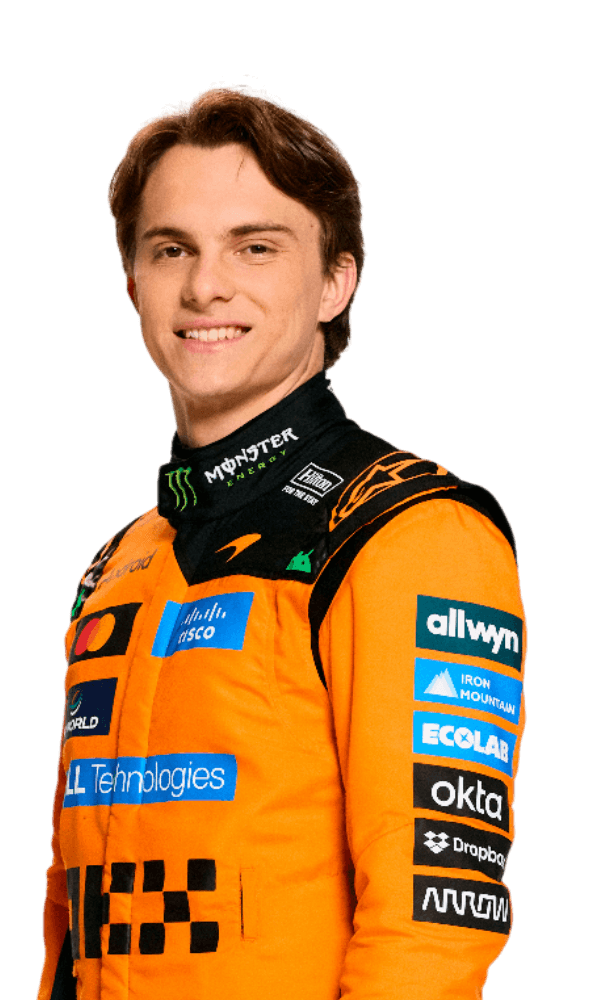
Oscar Piastri belongs to a generation of drivers who reached Formula 1 with virtually the strongest credentials possible. The Australian won three major titles in three consecutive seasons as he climbed the junior ranks, and quickly showed on reaching the top level that his success in the feeder series was no fluke.
His career is also notable for its unconventional beginnings. Before Piastri climbed into a kart, he competed with radio-controlled model cars. He grew up surrounded by machinery, while his family also had close ties to the automotive world. Gradually, a boy fascinated by cars became one of the most successful graduates of the modern Formula 1 junior ladder.
From model cars to karting
Oscar Jack Piastri was born on 6 April 2001 in Melbourne, Australia. He grew up in an environment where cars and engineering were a natural part of life. His grandfathers worked as mechanics, while his father Chris worked in the automotive industry.
But karting was not the young Piastri’s first real taste of competition. As a child, he raced radio-controlled cars and was already holding his own against much older competitors at the age of nine. Although it was a very different discipline from conventional motorsport, Piastri himself says it helped him understand the basics of racing lines and competition.
He took up karting at around the age of ten. His early outings were not flawless – on one of his first attempts, he even spun shortly after taking to the track – but the new sport immediately captured his interest.
He gradually established himself among Australia’s best young karters. He scored podium finishes in domestic championships, and it became clear that he would have to head to Europe if he wanted to continue at the highest level.
A difficult decision at 14
For Australian drivers, the road to Formula 1 presents one significant additional complication. The heart of European motorsport is thousands of miles from home, meaning young racers often have to choose very early between the comfort of family life and a professional career.
Piastri chose the latter.
At 14, he moved to England, where he attended school while continuing his karting career. He joined Ricky Flynn Motorsport and began competing regularly on European circuits.
His results in European karting were solid, but Piastri was not among those who completely dominated the category. He later acknowledged that he only really began to stand out after switching to single-seaters.
That was where his career began to gather pace.
A breakthrough in Formula 4
He gained his first experience of single-seaters in 2016. The following season in British Formula 4 revealed the young Australian’s potential.
Driving for Arden Motorsport, he won six races, took several pole positions and challenged for the title. He eventually finished runner-up to Britain’s Jamie Caroline, while also establishing himself as one of the championship’s standout rookies.
It was an important moment in his career. Although Piastri had been a strong karter, it was his single-seater results that began to mark him out as a serious prospect for progression towards Formula 1.
A move to the Formula Renault Eurocup followed.
His first full season in 2018 was primarily a learning experience. A year later, however, Piastri moved to R-ace GP and took his performance to an entirely different level.
In 2019, he won seven races, finished on the podium 11 times and claimed the Formula Renault Eurocup title.
It marked the beginning of an extraordinary run.
Three titles in three years
Piastri’s results caught the attention of the Renault Sport Academy, later renamed the Alpine Academy. Former Formula 1 driver and grand prix winner Mark Webber also became involved in his career, joining his management team.
In 2020, Piastri stepped up to FIA Formula 3 and signed with the successful PREMA Racing team.
Despite entering the season as a rookie, he won the opening race at the Red Bull Ring. His greatest strength throughout the season was not qualifying dominance but race consistency. Piastri did not take a single pole position all year, but regularly scored points and remained in title contention.
The championship was not decided until the finale at Mugello. Piastri ultimately prevailed in a close contest to become FIA Formula 3 champion at his first attempt.
Promotion to Formula 2 was the logical next step.
He stayed with PREMA for 2021 and was once again a rookie. This time, however, his performances were even more convincing. He improved significantly in qualifying, taking pole positions and combining speed with consistent results.
He secured the Formula 2 title before the final race of the season.
In the space of three years, he had won the Formula Renault Eurocup, FIA Formula 3 and FIA Formula 2 titles. That run firmly established him as one of the brightest talents waiting to enter Formula 1.
A champion without a Formula 1 seat
Even the Formula 2 title, however, did not immediately secure Piastri a place on the F1 grid.
With no race seat available to him for 2022, he became Alpine’s reserve driver. He used a year without regular racing to work in the simulator, test older cars and gain experience within the Formula 1 environment.
It was not his first experience of top-level machinery. He had first driven an F1 car in 2020, testing the Renault R.S.18 in Bahrain.
But it was in the summer of 2022 that Piastri became the centre of attention.
After Fernando Alonso’s departure from Alpine was announced, the French team publicly stated that Piastri would drive for it the following season. Shortly afterwards, the Australian announced that he would not be racing for Alpine in 2023.
A contractual dispute followed, which was considered by the FIA’s Contract Recognition Board. The tribunal unanimously ruled that the only valid contract for the 2023 and 2024 seasons was Piastri’s agreement with McLaren.
His path into Formula 1 was finally clear.
McLaren’s rookie
Piastri made his Formula 1 debut in 2023 alongside Lando Norris.
The start of the season was difficult. The McLaren MCL60 was among the less competitive cars in the opening races, and Piastri’s debut in Bahrain ended early with a technical problem.
Fittingly, he scored his first points at home in Melbourne, finishing eighth in the Australian Grand Prix.
The turning point came in the second half of the season. McLaren significantly improved its car, and both drivers began running regularly at the front.
Piastri came close to a podium in Britain and finished second in the Belgian sprint. He then claimed his first podium in a full-length Formula 1 race at the Japanese Grand Prix, finishing third.
Another significant moment followed two weeks later in Qatar. Piastri took pole position for the sprint and went on to win it. He finished second in the grand prix itself.
He had already demonstrated his ability to compete at the very front during his rookie season.
First Formula 1 victories
Piastri took another step forward in his second season.
His first grand prix victory came at the Hungaroring in 2024. Starting second, he moved into the lead ahead of team-mate Norris and emerged as the Hungarian Grand Prix winner after a strategically complicated race.
He was only the fifth Australian to win a Formula 1 world championship race.
His second victory, on the streets of Baku, was even more impressive. In the Azerbaijan Grand Prix, he made a decisive move on Charles Leclerc before withstanding pressure from the Ferrari for dozens of laps.
The result was also significant for McLaren, which moved to the top of the constructors’ championship at that stage.
Piastri completed every racing lap of the 2024 season and finished fourth overall in the drivers’ championship. Alongside Norris, he also helped McLaren secure its first constructors’ title since 1998.
In the space of two years, he had gone from a talented rookie to an established Formula 1 race winner.
Fighting at the front
The period that followed confirmed that Piastri’s ambitions extended beyond individual victories.
In 2025, he became a serious contender for the world championship for the first time. He won grands prix, took pole positions and led the championship for part of the season. He eventually finished third in the drivers’ standings.
The experience of a season-long title battle marked another significant step in his career. Piastri could draw on his junior experience, having become champion in three different ways – relying primarily on speed in Formula Renault, consistency in Formula 3 and a combination of both in Formula 2.
McLaren sees the Australian as part of its long-term future. The team extended his contract more than once during his early seasons, and Piastri became one of the key drivers in the project that returned the historic British outfit to the fight at the front.
A calm character and a technical mind
One trait that has characterised Piastri throughout his professional career is his calm demeanour.
The Australian himself describes his driving style as methodical and his approach in the cockpit as calm. He is known for his analytical handling of information and ability to adapt to new conditions, qualities that were already apparent during his rapid rise through the junior championships.
His technical interest in cars goes beyond his family background. Piastri has said that, had he not become a racing driver, he could have imagined a career as an engineer.
Away from the circuits, he maintains strong ties to Australia. He is a keen cricket fan and attends Australian national team matches when he is home. He also follows the Australian Football League, supporting Richmond Football Club.
Australia remains somewhere he regularly returns to between seasons to spend time with family and friends.
Why he races with number 81
Racing number 81 has become synonymous with Piastri.
Its origins date back to his karting days. He originally used number 11, which he put together using two “1” digits. But when another driver arrived at a race already entered with the same number, Piastri needed an alternative and eventually settled on 81.
He also used it in British Formula 4 and returned to it when he reached Formula 1.
Number 81 has since become one of his most recognisable trademarks.
One of the fastest routes to the top
Oscar Piastri’s story is not that of a driver who dominated every category from his first day in a kart. Rather, his career demonstrates a consistent ability to adapt to the next level and steadily improve his performance.
European karting gave him a foundation, but it was only in single-seaters that he showed his true potential. Finishing runner-up in British Formula 4 opened the door to the Formula Renault Eurocup, and an extraordinary run of three consecutive titles followed from 2019.
After a year as a reserve driver, he reached Formula 1 with McLaren and claimed podiums, a sprint win and grand prix victories within his first two seasons. He subsequently established himself among the drivers capable of fighting at the front of the world championship.
From a nine-year-old boy standing beside a track with an RC car controller to a Formula 1 race winner, Piastri has followed a path on which every step was harder than the last.
And he has risen to the challenge almost every time.
Teams raced for
Teams and race seasons recorded in our results archive (2023–2026).