


Overview
Current championship position
- Position
- 12
- Points
- 27
Driver biography: Franco Colapinto
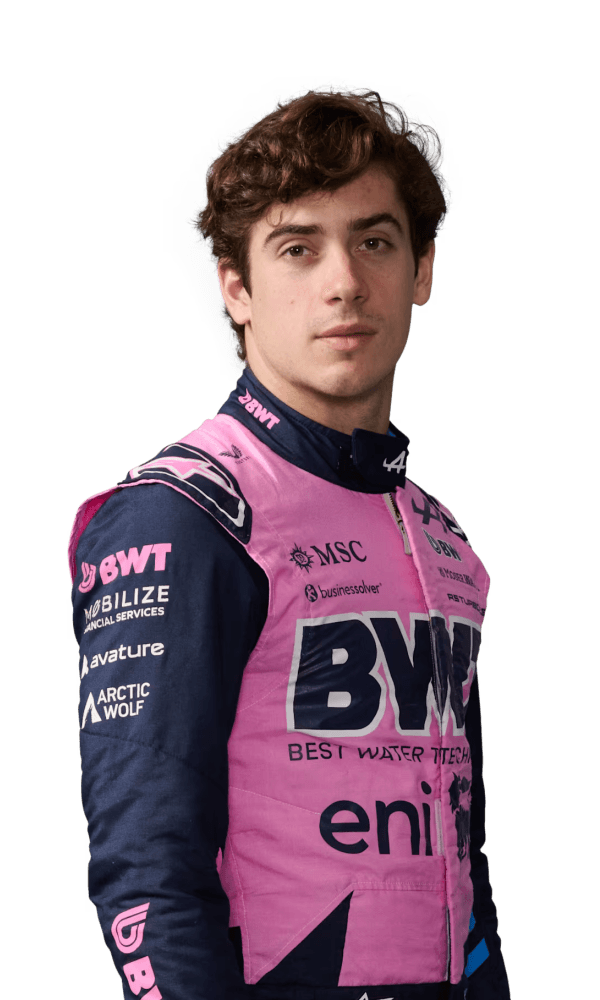
Franco Colapinto is one of those drivers whose route to Formula 1 was built not on a single dominant title in the leading junior categories, but on steadily establishing a reputation as a fast and adaptable racer. In a relatively short time, the Argentine made his mark in karting, junior single-seaters and endurance racing, before becoming his country’s first Formula 1 driver in more than two decades.
His career is also a story of leaving home at an early age, moving to Europe and spending years far from his family in an effort to break through in a world where hundreds of talented young drivers compete for a place on the grid.
Childhood in Argentina and an introduction to motorsport
Franco Alejandro Colapinto was born on 27 May 2003 in Argentina’s Buenos Aires province and grew up in the Pilar area, around 50 kilometres from the centre of the Argentine capital.
Sport was a natural part of his childhood. Like many Argentine boys, he played football and later made no secret of his support for Boca Juniors. But from an early age, machinery and speed held an even greater attraction.
His father, who had experience racing both motorcycles and cars, was a major influence. Colapinto rode a quad bike as a young boy and gradually began following not only Formula 1, but also domestic Argentine racing categories, including the popular Turismo Carretera.
He took up karting at around the age of nine. It was there that his competitive talent began to take shape, and he gradually achieved results that allowed him to consider a professional career.
By his teenage years, he understood that the road to Formula 1 would lead through Europe.
Leaving home at a young age
One of the defining moments of Colapinto’s life was his move from Argentina to Europe. Before his 15th birthday, he left familiar surroundings behind and began building his career, initially in European karting.
For the young Argentine, that meant not only much tougher competition, but also an entirely new way of life. He lived in Italy for a time and later in Spain, far from family and friends.
He later recalled how profoundly this period changed his life. He had to learn quickly to fend for himself while delivering performances in an environment where results determine future opportunities.
His European adventure soon began to pay off, however.
A first major success: the Spanish Formula 4 title
Colapinto moved into single-seaters at the end of 2018, making his debut in Spanish Formula 4. He showed his speed on his very first race weekend, winning one of the races.
The following season brought his first major career breakthrough.
In 2019, he contested the full Spanish F4 season with FA Racing by Drivex and dominated the championship. Over the course of the season, he took 11 wins, 13 podium finishes and 10 pole positions, securing the title by a substantial margin.
For Colapinto, it was proof that he could succeed beyond karting and had the potential to progress to higher single-seater categories.
He was still only 16 at the time.
Formula Renault and the Toyota Racing Series
The Formula 4 title was followed by another step up. In 2020, Colapinto competed in New Zealand’s Toyota Racing Series while also contesting a season in the European-based Formula Renault Eurocup.
He was among the standout rookies in the Toyota Racing Series. He finished third overall and won the rookie classification.
He also finished third in the Formula Renault Eurocup, racing for MP Motorsport. He took two wins during the season and was a regular visitor to the podium.
MP Motorsport would later become one of the most important teams in his career. Colapinto repeatedly returned to the Dutch outfit across several categories, eventually continuing with it all the way to Formula 2.
Adding prototypes to his single-seater programme
For a time, Colapinto’s path diverged from the typical programme of a young single-seater driver. In 2021, alongside another single-seater campaign, he began gaining experience in endurance racing.
He stayed with MP Motorsport in the Formula Regional European Championship by Alpine and won two races.
Alongside that, he got behind the wheel of an LMP2 prototype. He raced in the European Le Mans Series and Asian Le Mans Series, as well as selected rounds of the World Endurance Championship.
The most prestigious appearance of this period came at the 2021 24 Hours of Le Mans. While still a teenager, he gained experience of one of the world’s most famous motor races. His crew finished seventh in class.
He also took victory in the European Le Mans Series.
Experience of a much heavier prototype, navigating multi-class traffic and sharing a car with other drivers broadened his racing repertoire before he joined the main feeder ladder to Formula 1.
Formula 3: speed from the first weekend
In 2022, Colapinto reached FIA Formula 3, one of the most important categories on the road to F1.
He contested his first season with Van Amersfoort Racing, and a standout result came almost immediately. He took pole position on his debut in Bahrain.
His first win followed at Imola. He added a second victory at Monza at the end of the season and finished ninth in the standings. Alongside his two wins, he recorded five podium finishes.
Those results caught Williams’ attention.
Ahead of the 2023 season, Colapinto joined the Williams Racing Driver Academy, giving him his first direct link to a Formula 1 team. He also returned to MP Motorsport for a second F3 campaign.
This time, he was considerably more consistent. He won at Silverstone and Monza, added further podiums and ended the season fourth in the championship.
Although he did not win the title, his performances were convincing enough to earn him another step up the ladder.
Formula 2 and a step closer to Formula 1
He made his Formula 2 debut at the final round of the 2023 season in Abu Dhabi. A full-season seat with MP Motorsport followed in 2024.
He did not have to wait long for his first win. In the Imola sprint, he made a successful late move for the lead to claim his maiden F2 victory.
By then, however, his career was also progressing beyond the championship itself.
As a member of the Williams academy, he gained increasing exposure to Formula 1 machinery. He tested with the team and made his first appearance at an official F1 race weekend during the 2024 British Grand Prix at Silverstone, taking part in the opening practice session.
It was preparation for an opportunity that arrived much sooner than most people expected.
An unexpected opportunity at Williams
In August 2024, Williams decided to end its relationship with Logan Sargeant early and put Colapinto in its second car from the Italian Grand Prix.
The Argentine thus jumped straight from an ongoing Formula 2 campaign into Formula 1.
On his debut at Monza, he became the first Argentine driver to start an F1 grand prix since 2001. He also continued a rich Argentine tradition whose greatest figure remains five-time world champion Juan Manuel Fangio.
Colapinto needed just two starts to score his first points.
On the streets of Baku, he reached Q3 and finished eighth in the Azerbaijan Grand Prix. That made him the first Argentine to score points in Formula 1 since Carlos Reutemann in 1982.
He added another point with 10th place at the United States Grand Prix.
What stood out most about his arrival in F1 was how quickly he adapted. He stepped into the car without a conventional pre-season programme and, within a matter of weeks, had to learn to manage the tyres, procedures, energy and technical systems of a Formula 1 car.
The closing stages of his nine-race stint at Williams brought some more difficult moments and crashes, but his early performances were enough to establish his name in the paddock.
No vacancy at Williams
Despite his successful start, Colapinto had no guarantee of continuing.
Williams had Alex Albon under contract for the following season, with Carlos Sainz joining the team, leaving no race seat for the Argentine.
His performances, however, meant that he did not disappear from Formula 1 altogether.
At the start of 2025, he reached an agreement with Alpine, which secured his services through a multi-year deal with Williams. Colapinto began as the French team’s test and reserve driver.
He did not remain in that role for long either.
A return to the grid with Alpine
During the 2025 season, Alpine decided to change its driver line-up, giving Colapinto another opportunity. He replaced Jack Doohan from the Emilia Romagna Grand Prix, becoming Pierre Gasly’s team-mate.
His second arrival in Formula 1 came in different circumstances from his surprise debut with Williams. Alpine was going through a difficult period, and the car offered few opportunities to fight for points.
Despite a challenging season, the team retained its faith in Colapinto and kept him in the line-up for 2026.
His Formula 1 journey had thus evolved from a short-term stand-in opportunity into an effort to establish a secure place among the world championship’s 20 drivers.
Life away from the racing car
Although he has devoted much of his life to motorsport, Colapinto has several interests away from the circuits.
Cycling is an important part of his preparation. He particularly enjoys training in Mallorca, making use of its rolling roads and favourable conditions for longer rides. Cycling is a common training tool for Formula 1 drivers because it builds endurance without putting significant strain on the joints.
He also has a strong connection with football. As a child, he played almost every day and remained a fan of Argentine football after moving to Europe.
Music is another significant part of his life. He played guitar when he was younger and still describes music as an important part of his travels between grands prix. Among his close friends is Argentine producer Bizarrap, with the pair supporting each other at races and concerts.
Colapinto also has a technical mindset. He attended a technically focused school and took an interest in engineering when he was younger. That interest is a natural fit for motorsport, where a driver must communicate in detail with engineers and understand the behaviour of a complex racing car.
Monaco became his European base, as it has for many other Formula 1 drivers.
Despite his move onto the global sporting stage, his Argentine identity remains a prominent part of his public image. He speaks openly about his attachment to home, Argentine football, local culture and food, and his arrival in Formula 1 generated enormous interest in Argentina.
A new Argentine hope in Formula 1
Argentina has a rich motorsport history. Juan Manuel Fangio won five world championships in the 1950s, while Carlos Reutemann was a regular grand prix winner in the 1970s and 1980s.
After Gastón Mazzacane left the grid in 2001, however, the country waited more than two decades for another representative in Formula 1.
Colapinto ended that wait.
His route was far from straightforward. After leaving Argentina, he progressed through Spanish F4, the Formula Renault Eurocup, the Toyota Racing Series, Formula Regional, LMP2 prototypes, the 24 Hours of Le Mans, Formula 3 and Formula 2. Only then did the unexpected opportunity at Williams arrive.
That versatility is one of the defining features of his career. Even before entering F1, he had experience of both single-seaters and endurance prototypes, and had raced at circuits across Europe, Asia, Oceania and the Middle East.
From a boy riding a quad bike and racing karts near Buenos Aires to a place on the Formula 1 grid, Franco Colapinto has followed a path that required him to leave home as a teenager and gradually prove himself on one of the most competitive sporting ladders in the world.
His next chapter is now unfolding at the highest level of motorsport.
Teams raced for
Teams and race seasons recorded in our results archive (2024–2026).