

Overview
Current championship position
- Position
- 13
- Points
- 23
Driver biography: Oliver Bearman
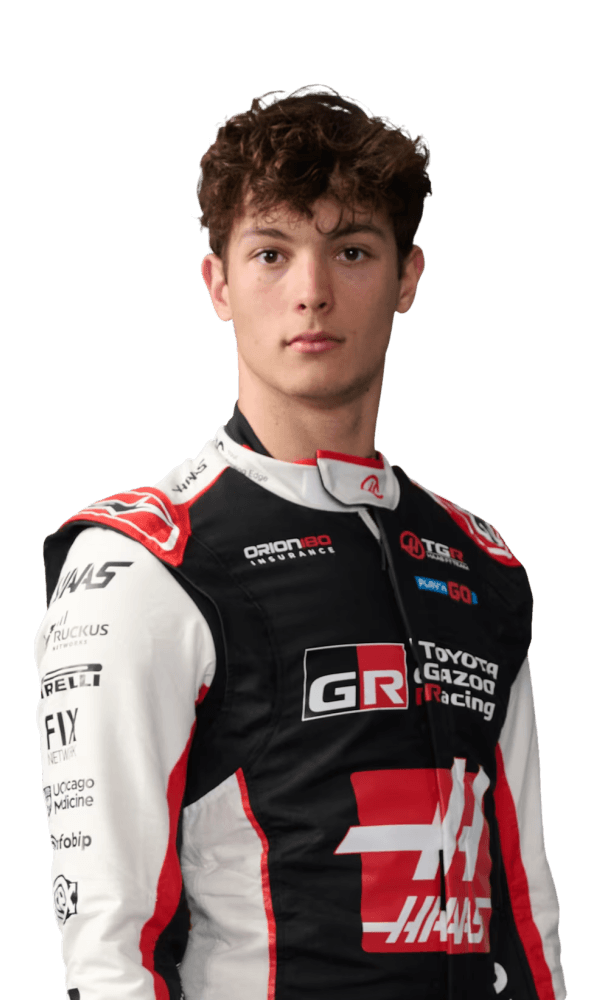
Oliver ‘Ollie’ Bearman made his way into Formula 1 remarkably quickly. In just a few years, the British driver progressed from karting through Formula 4, FIA Formula 3 and Formula 2 to join the 20 drivers at the pinnacle of motorsport. His rise featured major successes in the junior championships, a place in the prestigious Ferrari Driver Academy and, ultimately, an unexpected debut for Scuderia Ferrari itself.
Bearman was born on 8 May 2005 in Chelmsford, England. Motorsport was part of his life from an early age. His father David raced sports cars at club level, and Oliver would attend his races as a young boy. He later recalled that the sound of the engines, the smell of fuel and tyres and the speed of the cars sparked his interest in racing before he began driving more seriously himself.
Starting out in karting
He gained his first experience behind the wheel as a small child, but began organised karting at around eight years old. His progress was rapid. Over the following years, he established himself among Britain's successful young karters and gradually began delivering results internationally too.
In British karting, he made his mark at events including the Kartmasters British Grand Prix, while the 2019 season brought some of his most notable international results. Competing in X30 Junior, he enjoyed significant success, including victories in international competitions. It was this period that firmly suggested Bearman had the potential to pursue a professional career in motorsport.
The next logical step was the move from karting to single-seaters.
First wins in Formula 4
He moved into car racing in 2020. Joining US Racing, he competed in Germany's ADAC Formula 4 championship while also contesting part of the Italian Formula 4 season.
He did not have to wait long for his first major success, winning at Hockenheim during his rookie season. Looking back, he identified that first single-seater victory as one of the moments that truly launched his car racing career.
The 2021 season then brought a major breakthrough. Bearman switched to Van Amersfoort Racing and contested the German and Italian Formula 4 championships in parallel. The result was one of the most successful seasons of his junior career.
He took 11 victories in Italian Formula 4 to become champion. At the same time, he fought for the ADAC Formula 4 title, adding another six wins and securing a second championship. In a single year, he had conquered two of Europe's most important Formula 4 series.
He won 17 races across the two championships in total. He also competed in Britain's GB3 series, winning on one of his appearances.
Results like these could no longer go unnoticed, even at the highest level.
Joining the Ferrari Driver Academy
Following his successful 2021 season, Bearman was selected for the final stage of the Ferrari Driver Academy selection process. The Italian manufacturer's programme has long sought out young drivers with the potential to reach Formula 1.
Bearman came through the selection process successfully and joined Ferrari's academy. It was an immensely important step for his career.
The relationship with Ferrari meant more than financial or sporting support. At 16, Bearman moved to Italy and began adapting his life more closely to the demands of being a professional driver. He lived near Maranello, worked with engineers, fitness trainers and other members of Ferrari's programme, and had to learn to cope in a new environment far from his family.
He later admitted that this period forced him to grow up very quickly. He also learnt Italian and gradually became more deeply involved in Ferrari's organisation.
Formula 3 and an immediate title challenge
After his dominant year in Formula 4, Bearman stepped straight up to FIA Formula 3 for the 2022 season. He joined PREMA Racing, one of the world's most successful junior teams.
Once again, he established himself among the frontrunners almost immediately.
His rookie F3 season was not without mistakes, but he improved steadily as it progressed. He later recalled having to learn to take a more strategic approach to racing. Formula 4 had allowed him to drive much more aggressively, whereas F3 demanded better tyre management, patience and the ability to judge the right moment to attack.
Spa-Francorchamps in Belgium proved a significant weekend for him. He won the sprint and finished third in the feature race. It was his first Formula 3 victory and a result that firmly brought him into the championship fight.
He arrived at the final round of the season at Monza still in contention for the title. He ultimately finished third overall, just seven points behind champion Victor Martins.
For a rookie who had been racing in Formula 4 only a year earlier, it was an exceptionally impressive result. Ferrari and PREMA therefore decided to move him straight up another rung.
Formula 2 and an unforgettable Baku weekend
In 2023, Bearman became an FIA Formula 2 driver, once again racing for PREMA Racing.
He needed little time to adapt to the second-highest single-seater category either. The real breakthrough came as early as the round on the streets of Baku.
There, Bearman delivered one of the most complete weekends in modern Formula 2 history. He was fastest in practice, took pole position and then won both the sprint and the feature race. He became the first driver in this generation of the F2 championship to top every competitive session over a single weekend.
He added further victories in Barcelona and Monza during the season. He ended his first Formula 2 campaign with four wins and sixth place in the standings.
More importantly, though, he was also beginning to move closer to Formula 1.
First laps in Formula 1
Ferrari gradually involved its junior driver in Formula 1-related work. Bearman spent considerable time in the simulator and was also given opportunities to drive older Ferrari F1 cars.
In 2023, he completed a test at Ferrari's home circuit, Fiorano. A partnership with Haas followed, the team having long maintained a technical relationship with Ferrari.
Bearman was given the chance to take part in first practice at the Mexican Grand Prix and later in Abu Dhabi. These were the young driver's first opportunities to measure himself directly against regular Formula 1 drivers during a race weekend.
His performances impressed Haas's management, particularly future team principal Ayao Komatsu. Bearman subsequently secured further Formula 1 running and was appointed reserve driver for both Ferrari and Haas for 2024.
Nobody, however, expected his race debut to come quite so soon.
The phone call that changed his career
The 2024 Saudi Arabian Grand Prix was supposed to be primarily another Formula 2 weekend for Bearman. He had even taken pole position in qualifying.
Then came some unexpected news.
Ferrari driver Carlos Sainz needed surgery for appendicitis, and the team required a replacement. They chose Bearman, who was then 18 years old.
He learnt that he would be racing for Ferrari only shortly before third practice. That left him with just one hour of practice before qualifying in the SF-24, a car he had never previously driven in competitive conditions.
Despite the minimal preparation, he delivered a remarkably composed performance. In qualifying, he missed out on reaching the final segment by just a few hundredths of a second.
He then finished seventh in the race.
He had immediately scored six points on his first Formula 1 start. He also became the youngest Ferrari driver to score points in a Formula 1 World Championship race.
It was the moment that introduced Bearman to the wider public almost overnight.
From stand-in to full-time Haas driver
Although Formula 2 remained his main programme, he was given further opportunities in the Haas during 2024. In July, the team announced that it had signed Bearman on a multi-year contract and that he would become one of its full-time Formula 1 drivers from the 2025 season.
Before then, however, he made further race appearances.
At the Azerbaijan Grand Prix, he replaced the suspended Kevin Magnussen and finished 10th. That earned him a point on his first start for Haas too. He became the first driver in Formula 1 history to score points for two different teams in his first two Grands Prix.
He later stood in for Magnussen again in São Paulo.
His second Formula 2 season was an unusual one. His Formula 1 commitments disrupted his original programme, yet he still managed to win three F2 races – in Austria, Monza and Qatar. He therefore ended the junior phase of his career with a total of seven victories across two F2 seasons.
The main objective, however, had already been achieved. He had become a Formula 1 driver.
A first full season at the highest level
In 2025, Bearman began his first full Formula 1 season as a Haas driver. The experienced Esteban Ocon became his team-mate.
The start of the season brought some typical rookie mistakes, and Bearman later openly admitted that he could have handled certain situations better. Gradually, however, he gained experience of working through a full race weekend, setting up the car, managing tyres and communicating with the team.
His standout result came at the Mexican Grand Prix, where he finished fourth. That matched Haas's best result in a Formula 1 race. A week later, he added sixth place in São Paulo.
He ended the season 13th in the standings with 41 points and established himself as a regular member of the grid. He would enter the following campaign no longer a rookie, with a full season's experience behind him.
Ferrari remains part of his story
Even after his move into Haas's full-time line-up, Ferrari remained an important part of Bearman's career. It was the Italian manufacturer that brought him into its driver academy, gave him extensive preparation in the simulator and Formula 1 cars, and helped create a route to a permanent place on the grid through its partnership with Haas.
Bearman makes no secret of the fact that racing for Ferrari is one of his long-term career goals. At the same time, he stresses the importance of his own development at Haas, where he can gain experience without his career depending solely on a future opportunity at Maranello.
The connection between Bearman and Ferrari is therefore important to understanding his career, but his development in Formula 1 depends above all on the performances he can deliver for his current team.
Life away from the circuit
Despite entering professional motorsport at a very young age, Bearman has remained close to his family. He has pointed out several times that the journey to the highest level also required considerable sacrifices from his parents.
His younger brother Thomas also competed in karting. Oliver often speaks of his family as an important part of his life and, even after moving away to pursue his career, tries to spend his free time with those closest to him.
After spending several years in Italy, he later moved to Monaco, as have a number of other Formula 1 drivers.
Away from motorsport, he enjoys cycling, which also forms part of his fitness training. He does, however, jokingly admit that he still has a long way to go compared with professional cyclists. He is also interested in football and said in one interview that, if he could try another professional sporting career for a day, he would choose to be a footballer or a cyclist.
In his free time, he enjoys watching films and television series, and he tries to use the travel that is an integral part of a Formula 1 driver's life to explore places beyond the circuits.
Among the drivers he has mentioned looking up to are Ayrton Senna and Michael Schumacher. Schumacher's successful era at Ferrari and his work ethic are a particular source of inspiration for Bearman.
A driver who seized his opportunity
Oliver Bearman's career is an example of an exceptionally rapid rise through junior motorsport. From his early years in karting, through two Formula 4 titles, an FIA Formula 3 title challenge and victories in Formula 2, it took only a handful of seasons for him to reach Formula 1.
Each of those steps played a different role. Formula 4 demonstrated his speed and ability to win championships. Formula 3 taught him greater patience and how to work with race strategy. Formula 2 added experience of tyre degradation, pit stops and more technically demanding cars. The Ferrari Driver Academy, meanwhile, prepared him for the professional environment of Formula 1.
The defining moment of that journey remains his debut in Saudi Arabia in 2024. Bearman was handed one of the most demanding opportunities a young driver could face – stepping straight into a Ferrari midway through a race weekend with virtually no preparation. Seventh place showed that he could handle not only the speed of a Formula 1 car, but also the pressure of driving for the sport's most famous team.
He subsequently went from stand-in to full-time Haas driver, beginning another chapter of his career. After years in which reaching Formula 1 had been the main objective, his task had changed. The question was no longer whether he could reach the top level, but what he could build there.
What happens next will reveal just how far the career of one of the most prominent British drivers of his generation can go.
Teams raced for
Teams and race seasons recorded in our results archive (2024–2026).