


Overview
Current championship position
- Position
- 10
- Points
- 42
Driver biography: Pierre Gasly
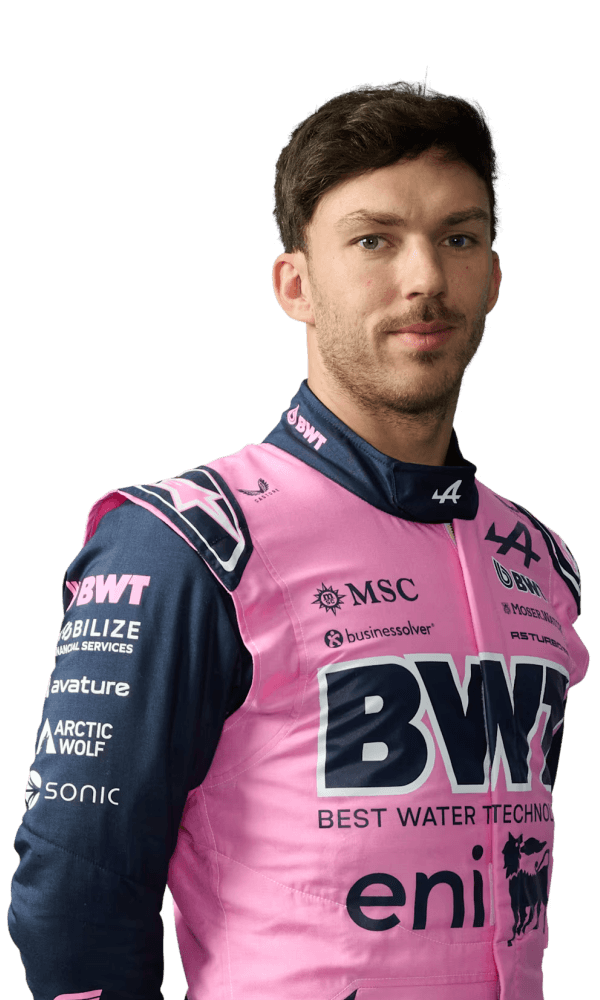
Pierre Gasly belongs to a generation of French drivers who made their mark on Formula 1 in the late 2010s and early 2020s. His path to the top, however, was far from straightforward. Gasly rose rapidly through the junior ranks, won the GP2 title, joined one of Formula 1’s strongest teams, endured a painful demotion to its junior outfit and then rebuilt his career, culminating in a sensational Italian Grand Prix victory.
The French driver was born on 7 February 1996 in Rouen, Normandy. Motorsport was already familiar territory within his family. His grandparents had experience of karting and motorsport, and Gasly first got behind the wheel of a kart at the age of six. He later recalled those first laps at a track near his home as the moment he was immediately captivated by the speed, adrenaline and sheer intensity of driving.
From karting to single-seaters
Gasly began competing in French and international karting. His talent caught the attention of the French motorsport federation, the FFSA, which included him among the young drivers it supported. While still in his teens, he was part of a generation of French talent that would eventually produce several Formula 1 drivers.
During this period, Gasly also encountered future world championship rivals. He knew Esteban Ocon from an early age and raced against or worked with drivers such as Charles Leclerc, Max Verstappen and Alexander Albon during his junior career. The fierce competition within his generation became an important part of his development as a driver.
He made his single-seater debut in the French F4 Championship. Third in the standings in his first season confirmed that he could carry his karting pace over into single-seaters.
A move into Formula Renault followed. The decisive season for his future career came in 2013, when he won the Formula Renault 2.0 Eurocup title. It was more than just a sporting trophy. That success secured the financial backing he needed to continue at a higher level and significantly raised his stock with young driver programmes.
Gasly subsequently joined the Red Bull junior programme, which was already supporting the careers of several future Formula 1 drivers. In 2014, he moved up to the Formula Renault 3.5 Series and finished second in the standings. His next step was the GP2 Series, then the leading junior category immediately below Formula 1.
A GP2 title and the Japanese route to F1
His first full GP2 season in 2015 did not bring an immediate title challenge. Gasly finished eighth, but Red Bull stood by him and gave him another opportunity the following year.
In 2016, he made the most of it.
Driving for Prema Racing, he fought for the title against rivals including Antonio Giovinazzi and ended the season as GP2 champion. Yet, paradoxically, winning the title in the leading junior category did not lead to an immediate move into Formula 1.
Instead, Red Bull sent him to Japan, where he competed in the fiercely competitive Super Formula championship in 2017. For a young European, that meant not only learning new circuits and cars but also working in an entirely different cultural and technical environment. Gasly later said that his time in Japan had forced him to focus more closely on the technical side of racing and on communicating precisely with his engineers.
He was immediately competitive in Japan, too. He went into the closing stages of the season as a title contender and ultimately finished second in the championship, just half a point behind Hiroaki Ishiura. The final races of the season at Suzuka were cancelled because of bad weather, denying Gasly the chance to fight for the title on track.
By then, however, the news he had been waiting for since childhood had already arrived.
Formula 1 debut
Gasly made his Formula 1 debut for Toro Rosso at the 2017 Malaysian Grand Prix. The team brought him in to replace Daniil Kvyat, giving the Frenchman an opportunity to contest the closing part of the season. His performances were enough to secure a full-time seat for the following year.
The 2018 season was his first full campaign in Formula 1 and also the first year of Toro Rosso’s partnership with Honda. At only the second race of the year, in Bahrain, Gasly finished fourth. For a team that was not a regular contender for the leading positions, it was an outstanding result.
His performances, combined with Daniel Ricciardo’s departure from Red Bull Racing, opened the door to a rapid promotion. Ahead of the 2019 season, Gasly became Max Verstappen’s team-mate at one of the championship’s strongest teams.
It was supposed to mark the start of a new chapter in his career. Instead, it brought his most difficult period.
Red Bull and a painful demotion
At Red Bull, Gasly was unable to get consistently close to Verstappen’s level of performance. The gap between the team-mates was particularly pronounced in qualifying, and Red Bull decided to make a change during the 2019 summer break. Gasly had to return to Toro Rosso, with Alexander Albon taking his place.
For a driver who had been given the opportunity of a lifetime only a few months earlier, it was a major career setback.
That difficult period was also marked by personal tragedy. In August 2019, Anthoine Hubert, one of Gasly’s close friends, was killed in an accident during a Formula 2 race at Spa-Francorchamps. Gasly spoke repeatedly about the loss of the French driver in the years that followed, and Hubert remained an important part of his personal memories of motorsport.
After returning to Toro Rosso, however, Gasly gradually began producing some of the best performances of his career to that point. The 2019 Brazilian Grand Prix provided a symbolic culmination. He battled Lewis Hamilton in the closing stages and finished second after a close sprint to the line.
It was his first Formula 1 podium and confirmation that his failure at Red Bull did not have to mean the end of his career at the highest level.
Monza 2020: the day that changed Gasly’s career
Toro Rosso was renamed AlphaTauri ahead of the 2020 season. It was with this team that Gasly achieved the biggest result of his career.
The 2020 Italian Grand Prix at Monza unfolded in unpredictable fashion. A safety car, penalties, a race stoppage and problems for the favourites shuffled the order. After the restart, Gasly found himself in a position to fight for victory.
In the closing stages, he had to withstand pressure from Carlos Sainz. He held on to the lead to the chequered flag and claimed his first Formula 1 victory on 6 September 2020.
Gasly became the first French driver to win an F1 Grand Prix since Olivier Panis’s triumph in Monaco in 1996. For Gasly himself, the victory carried even greater significance. It came roughly a year after his demotion from Red Bull and after a period in which his future at the top might have appeared uncertain.
Monza also cemented Gasly’s position as AlphaTauri’s leader.
Leading AlphaTauri
The following season, 2021, was one of his most consistent years in Formula 1. Gasly regularly reached the final stages of qualifying and secured another podium at the Azerbaijan Grand Prix.
He scored 110 of AlphaTauri’s 142 points during the season and finished ninth in the drivers’ standings. In doing so, he demonstrated that his Monza success was not an isolated result.
In 2022, however, the team’s performance declined, and Gasly decided to make a move that would take him out of the Red Bull fold for good. After years with Toro Rosso, Red Bull and AlphaTauri, he accepted an offer from French team Alpine.
A new chapter with Alpine
Gasly joined Alpine for the 2023 season. His initial team-mate was Esteban Ocon, whom he had known almost since the start of his karting career.
His first major successes in his new colours came during that opening season. In a challenging wet race at Zandvoort, Gasly finished third to secure his first podium as an Alpine driver. He also delivered a strong result in the Belgian sprint, where he again finished third.
Another podium followed in the dramatic 2024 São Paulo Grand Prix. In wet conditions, Gasly finished third behind winner Max Verstappen and team-mate Ocon, giving Alpine second and third places. Gasly ended the season tenth in the drivers’ standings.
He remained with the French team in the seasons that followed. At Monza, the circuit associated with his greatest triumph, he added another career milestone in 2026. In qualifying for the Italian Grand Prix, he secured his first Formula 1 pole position. Even after years in the championship, he was still able to add another first to his record.
Life outside the cockpit
Sport plays a prominent role in Gasly’s life away from Formula 1. He has long been interested in football and has also spent his spare time playing golf, football, bowling and other competitive sports. In interviews, he has repeatedly admitted that his competitive streak does not disappear when he leaves the circuit.
Football is one of his main interests. Gasly is a fan of the sport and, in 2024, became a co-owner of French football club FC Versailles.
He has also developed a growing interest in fashion. That interest is linked in part to his life in Milan, one of the global centres of the fashion industry. Gasly attends fashion events and describes clothing as a way to express his creativity outside motorsport.
Sport and physical activity nevertheless remain a natural part of his daily life. Alongside the training required for Formula 1, he enjoys running, cycling, golf and racket sports.
A career built on comebacks
Pierre Gasly did not reach Formula 1 on the strength of a single exceptional result. Before making his debut, he had won titles in the Formula Renault Eurocup and GP2, finished second in Formula Renault 3.5 and challenged for the title in Japan’s Super Formula championship.
What has defined his career at the highest level, however, is his ability to respond to setbacks. His rapid promotion to Red Bull in 2019 ended after roughly half a season. But rather than a gradual exit from Formula 1, what followed was a first podium, victory at Monza, further podium finishes and, later, a first pole position.
Gasly’s story is therefore more than the journey of a junior champion into Formula 1. It is also the story of a driver who managed to rebuild his career after one of its most difficult periods and gradually established a secure place among the world championship’s experienced competitors.
Teams raced for
Teams and race seasons recorded in our results archive (2017–2026).