


Overview
Current championship position
- Position
- 23
- Points
- 0
Driver biography: Sergio Pérez
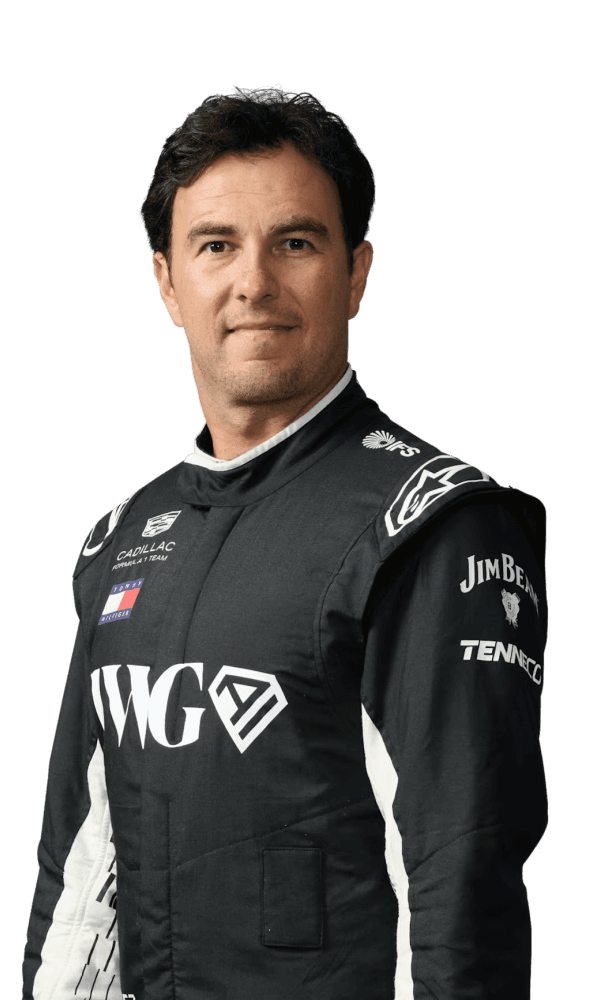
Throughout his career, Sergio Pérez has built a reputation as a driver capable of turning patience, tyre management and an ability to seize unexpected opportunities into results that often exceeded his car’s potential. The Mexican, nicknamed Checo, progressed from karting through the British junior categories to Formula 1 victories, a spell at Red Bull and, ultimately, another chapter in his career with the Cadillac project.
Beginnings in Guadalajara
Sergio Michel Pérez Mendoza was born on 26 January 1990 in Guadalajara, Mexico. Motorsport was part of his upbringing. His father, Antonio Pérez Garibay, was involved in motor racing, while his older brother, Antonio Pérez, later enjoyed success in Mexico’s NASCAR series.
Sergio began karting at the age of six. From an early age, he was among the youngest competitors in his categories. He was already using the number 11, which he later adopted as his permanent Formula 1 race number, during his karting career.
Support from the Mexican Escudería Telmex programme, which helped talented local drivers reach international championships, played a significant role in his development. For Pérez, it provided an opportunity to leave Mexico and gradually move into the environment in which future Formula 1 drivers were being prepared.
Moving abroad and into Europe’s junior categories
After karting, Pérez moved into single-seaters. In 2004, he competed in the North American Skip Barber Formula Dodge series before moving to Europe at the age of 15.
In 2005 and 2006, he raced in German Formula BMW. For the young Mexican, this meant not only a higher level of competition but also a major change in his life. Far from his family, he had to establish himself against European opposition.
British Formula 3 was another important step. In 2007, he dominated the National Class, taking 14 victories. A year later, he competed in the main British F3 class and finished fourth in the standings. His results in Britain brought greater attention to a driver who, until then, had not been among the best-known junior names outside Mexico.
Pérez also appeared in A1 Grand Prix before progressing to GP2, then the leading feeder series to Formula 1.
GP2 opens the door to Formula 1
Some of his first experience of GP2 machinery came in the championship’s Asian series. At 18, he became its youngest race winner.
He completed his first full season in the main GP2 championship with Arden in 2009. A significant step forward followed his move to Barwa Addax for 2010.
Pérez won five races that year and challenged for the title. He finished second in the standings behind Pastor Maldonado. Those results paved the way for his move to the top category.
During the same period, he joined the Ferrari Driver Academy, and Sauber offered him a Formula 1 seat for 2011. At the end of 2010, he also drove a Sauber in the young driver test in Abu Dhabi.
Sauber: the first big surprises
Pérez made his Formula 1 debut in 2011 alongside Kamui Kobayashi. His very first start in Australia highlighted what would become one of his defining qualities: the ability to look after his tyres. He initially finished seventh on a one-stop strategy, but both Saubers were subsequently disqualified for a technical infringement.
His first season was also affected by a qualifying crash at the Monaco Grand Prix. After hitting the barrier, he had to miss the race and also sat out the following Canadian Grand Prix on medical grounds.
His real breakthrough came in 2012.
At the rain-affected Malaysian Grand Prix, he put his Sauber in contention for victory against Fernando Alonso. Pérez eventually finished second, securing his first Formula 1 podium.
It was no fluke. He added third place in Canada and another second place at Monza. Three podiums with a midfield team made him one of the most sought-after young drivers on the grid.
A big opportunity at McLaren
When Lewis Hamilton left McLaren for Mercedes at the end of 2012, the British team chose Pérez as his replacement.
The move ahead of the 2013 season was supposed to take him to the very front of the field. But McLaren produced a car that could not build on the previous year’s results.
Pérez raced alongside world champion Jenson Button and caught the eye on several occasions with aggressive wheel-to-wheel battles, but a standout result never came. After just one season, McLaren decided to part ways with him.
It was one of the most critical moments of Pérez’s career. After his rapid rise from Sauber to a major team, he found himself without a guaranteed seat for the following season.
Force India: where he built his reputation
A deal with Force India for 2014 offered a lifeline. What initially looked like a short-term opportunity became one of the longest and most important spells of his career.
He finished third in Bahrain in his first season. In the years that followed, he repeatedly demonstrated his ability to capitalise on strategically unpredictable races and use his tyre management to extend stints in ways other drivers could not match.
Further podiums came in Russia in 2015, Monaco and Azerbaijan in 2016, and Azerbaijan again in 2018. For a team with a substantially smaller budget than its biggest rivals, these were exceptionally valuable results.
His time at Force India was not without conflict. Particularly in 2017, he made contact with team-mate Esteban Ocon on several occasions, prompting the team to impose stricter rules on how its drivers raced each other.
Helping save the team and the birth of Racing Point
The 2018 season brought problems that went beyond results on track. Force India ran into serious financial difficulties.
Pérez was one of the creditors who took legal action that led to the company entering administration. He explained that the aim was to make it possible to save the team and its jobs.
A consortium led by Lawrence Stroll subsequently took over the team, which began operating as Racing Point after a transitional period.
Pérez remained its key driver.
Sakhir 2020: a victory almost ten years in the making
The 2020 season became one of the most important of his life.
Racing Point had a competitive car, and Pérez took a podium in Turkey. But he already knew he would have to leave the team at the end of the season, with four-time world champion Sebastian Vettel set to take his seat.
Then came the Sakhir Grand Prix.
A first-lap collision left Pérez at the back of the field and forced him to pit. But rather than a lost race, what followed was one of the most impressive recovery drives of his career.
He worked his way back among the leaders and, after a dramatic race, claimed his first Formula 1 victory.
He had waited 190 starts for that win. At a time when he had no confirmed seat for the following year, he delivered a performance that would have a major influence on the next stage of his career.
Red Bull and a new chapter
Ahead of the 2021 season, Red Bull was looking for a more experienced team-mate for Max Verstappen and chose Pérez.
He won in Azerbaijan in only his sixth Grand Prix for his new team. At the end of the season, he also played an important supporting role in the title decider in Abu Dhabi, significantly delaying Lewis Hamilton at one stage and allowing Verstappen to close the gap.
His first season at Red Bull also highlighted the challenge of adapting to a car built around very specific handling characteristics. Nevertheless, Pérez delivered enough results to retain his place.
Monaco winner
2022 brought another step forward in his career.
In Saudi Arabia, he secured his first Formula 1 pole position. It came at his 215th qualifying appearance, which at the time was the longest wait for a maiden pole in the championship’s history.
A few weeks later, he achieved one of the most prized successes of his career: victory in the Monaco Grand Prix. In a race shaped by rain and strategy, he moved ahead of the Ferraris and kept Carlos Sainz behind him.
Later that season, he also won in Singapore. Street circuits were increasingly becoming the venues for some of his most impressive results.
He finished the season third in the world championship.
World championship runner-up
The start of the 2023 season suggested Pérez might be able to keep pace with Verstappen for longer.
He won in Saudi Arabia and then Azerbaijan, where he also won the sprint. After the opening races, he remained in contention at the top of the championship.
Gradually, however, he began to lose ground. He struggled particularly in qualifying, failing to reach the final segment on several occasions despite Red Bull having a dominant car.
Despite his inconsistent form, he scored enough points to secure second place in the drivers’ world championship. It was the best championship finish of his career, while Red Bull secured its first-ever one-two in the drivers’ standings.
A difficult end to his time at Red Bull
Pérez began 2024 with a series of strong results and signed a new multi-year contract extension with Red Bull during the season.
His form gradually deteriorated, however. While Verstappen fought for another title, Pérez increasingly dropped out of contention for the leading positions, and his points contribution fell sharply.
After the season, Red Bull and Pérez agreed to part ways.
Nevertheless, his four years with the team marked the most successful period of his career up to that point. He took five of his first six Formula 1 victories with Red Bull and was part of the line-up that helped the team win two constructors’ titles.
A year off the grid and a return with Cadillac
Pérez did not race in Formula 1 in 2025. For the first time since his debut in 2011, he spent an entire season off the grid.
But the break did not mark the definitive end of his career.
New team Cadillac, preparing to enter Formula 1, selected Pérez alongside Valtteri Bottas as its first two race drivers.
For the American newcomer, the experienced pairing offered an opportunity to build the project’s foundations around drivers with hundreds of Grands Prix behind them. For Pérez, the deal meant a return to the championship and another stage of his career after years spent with established, successful teams.
Driving style and ‘Checo’ the survivor
Throughout his years in Formula 1, Pérez has repeatedly been associated with an ability to manage his tyres.
He could complete long stints without a dramatic drop in pace, giving his teams more strategic options. This quality was particularly apparent during his years at Sauber, Force India and Racing Point.
He also developed a reputation as a driver who could capitalise on chaotic races. Several of his podiums and his first victory came in situations that demanded the right response to a safety car, changing weather or unusual strategies.
He often delivered strong results on street circuits. His wins include Baku, Monaco, Singapore and Jeddah, tracks where precision when driving close to the barriers is particularly important.
Family, football and life away from the track
Pérez has guarded his privacy more closely than some of his rivals throughout his career, although several aspects of his life away from the track are publicly known.
He is married to Carola Martínez and has children. He has repeatedly described his family as one of the most important parts of his life and has spent much of his time between seasons at home in Mexico.
His best-known sporting interest outside motorsport is football. He played as a child and continued to do so in his spare time during his Formula 1 career. In the past, he has spoken about having his own team with friends and described himself as a striker.
His other publicly known interests include collecting watches. Pérez has said he bought watches to mark significant events in his life, serving as reminders of those occasions.
He is also involved in charitable work in Mexico through the foundation bearing his name, which supports disadvantaged children and families.
The most successful Mexican driver of the modern era
When Pérez entered Formula 1, Mexico had waited decades for a regular driver in the championship. He gradually became one of the leading symbols of the country’s return to the world motorsport map.
His significance grew further with the revival of the Mexican Grand Prix. His home race at the Autódromo Hermanos Rodríguez regularly drew enormous support from Mexican fans, and Pérez became the central figure of the entire weekend.
At his home circuit, he also became the first Mexican to stand on the podium at a Formula 1 Mexican Grand Prix.
His career has not been a story of uninterrupted progress. There was the rapid rise with Sauber, an unsuccessful season at McLaren, long years building his reputation at Force India, an almost lost Formula 1 seat, a first victory after nearly ten seasons and, subsequently, his most successful period at Red Bull.
That ability to find a route back to the grid after career setbacks has become one of the defining features of Pérez’s motorsport story. From a six-year-old boy in a kart in Mexico, he went on to win in Monaco, Baku and Singapore, finish runner-up in the world championship and earn more than one opportunity to start almost afresh in Formula 1.
Teams raced for
Teams and race seasons recorded in our results archive (2011–2026).