


Overview
Current championship position
- Position
- 18
- Points
- 7
Driver biography: Carlos Sainz
Carlos Sainz grew up in an environment where motorsport was a natural part of life, but his own path began to diverge from his father’s relatively early. The son of two-time World Rally Champion Carlos Sainz Sr chose single-seaters over gravel roads and special stages. He worked his way through karting and the junior single-seater ranks to Formula 1, where he has represented several major teams and joined the ranks of grand prix winners.
Growing up in the shadow of a famous name
Carlos Sainz Vázquez de Castro was born on 1 September 1994 in Madrid. His father, Carlos Sainz, is one of Spain’s most successful racing drivers, having won two World Rally Championship titles before going on to enjoy considerable success in the Dakar Rally.
For the young Carlos, that meant an exceptional upbringing, but also a name that carried high expectations. He later acknowledged that, early in his career, he was often seen primarily as “Carlos Sainz’s son”. Over the years, however, he worked to establish his own identity as a racing driver.
Despite the family tradition, he found himself drawn more to circuit racing than rallying. Fernando Alonso played a significant role in that. Alonso’s first major Formula 1 successes in the early years of the new millennium were among the things that inspired Sainz to aim for a place in the same championship one day.
He began karting at around the age of 10, and over the following years it became clear that motorsport would be more than just a family hobby.
First steps in single-seaters
After karting, Sainz moved into single-seater racing in 2010. One of his first major championships was Formula BMW Europe, where he finished fourth overall in his rookie season.
Around the same time, he joined the Red Bull junior programme. Support from one of motorsport’s leading driver academies was crucial to his subsequent career, but it also brought constant pressure to deliver results. The Red Bull programme was known for offering young drivers a route all the way to Formula 1, but only if they consistently proved their ability.
Sainz secured his first major title in the 2011 Formula Renault 2.0 Northern European Cup. He won 10 races during the season to become series champion. He also finished runner-up in the prestigious Formula Renault 2.0 Eurocup.
A move to Formula 3 followed. In 2012, he competed in the British F3 championship and European races in the category, among other commitments. He won several races in the British series and finished fifth in the FIA European standings.
The 2013 season was less straightforward. Sainz raced in GP3 while also contesting selected Formula Renault 3.5 rounds. His GP3 results fell short of both his own ambitions and Red Bull’s expectations, but the experience proved valuable preparation for the decisive year of his junior career.
The title that opened the door to Formula 1
In 2014, Sainz was given the opportunity to contest a full Formula Renault 3.5 season with DAMS. At the time, the championship was one of the leading final stepping stones to Formula 1.
Sainz delivered a convincing campaign. He claimed seven victories and seven pole positions to become Formula Renault 3.5 champion. Among those he beat to the title was fellow Red Bull junior Pierre Gasly.
It was a decisive success. Red Bull had already given Sainz opportunities to test Formula 1 cars, and his title earned him the chance he had been working towards throughout his junior career. Toro Rosso named him in its driver line-up for the 2015 season.
His team-mate was Max Verstappen.
A debut alongside Max Verstappen
Sainz made his Formula 1 grand prix debut in Australia in 2015. Toro Rosso had one of the youngest driver line-ups in the championship’s history, and much of the attention focused on Verstappen, who was just 17.
Yet Sainz showed in his opening season that he had reached Formula 1 on more than his name or Red Bull’s backing alone. He regularly fought for points and remained with Toro Rosso in the seasons that followed.
A pivotal moment came in 2016. Red Bull decided to promote Verstappen to its senior team, while Sainz stayed at Toro Rosso. His own path thus began to diverge from the system that had brought him into Formula 1.
During the 2017 season, he was given the opportunity to move to the Renault works team. He contested the final races of the year in the French team’s yellow-and-black car and stayed with Renault the following season.
McLaren and a first podium
The next major chapter began in 2019. Sainz joined McLaren, forming a driver pairing with rookie Lando Norris.
The move proved to be one of the most important steps of his career. McLaren was working its way back towards the front of the field, and Sainz was given the opportunity to take on a more prominent role within the team.
His first Formula 1 podium came at the 2019 Brazilian Grand Prix. Technical problems in qualifying left him starting at the back of the field, but he fought his way up to fourth during the race. A post-race penalty for Lewis Hamilton promoted him to third.
It was Sainz’s first career podium and McLaren’s first top-three finish since 2014.
A year later, he came even closer to a maiden victory. At the 2020 Italian Grand Prix at Monza, he finished second, just 0.415 seconds behind winner Pierre Gasly.
By then, however, the next step in his career had already been decided.
Ferrari
When Ferrari decided to part ways with Sebastian Vettel after the 2020 season, it chose Sainz as his replacement. He duly became Charles Leclerc’s team-mate in 2021.
Joining the most successful team in Formula 1 history brought a new level of expectation. But Sainz took several podiums in his first season and quickly adapted to his new surroundings.
The biggest moment of his career to that point came at Silverstone in 2022.
He claimed his first Formula 1 pole position in qualifying for the British Grand Prix. The following day, he converted it into his maiden victory, on his 150th grand prix start.
Victory at one of the world’s most famous circuits firmly established Sainz as a Formula 1 race winner.
Singapore and a strategic victory
Another notable triumph followed in Singapore during the 2023 season.
Ferrari had a competitive car there, and Sainz secured pole position. In the race, he then delivered a performance that highlighted one of his greatest strengths: his ability to think strategically behind the wheel.
In the closing stages, he deliberately kept Lando Norris close enough behind to use DRS, making it harder for the Mercedes drivers to attack. The tactic worked, and Sainz claimed his second Formula 1 victory.
His triumph was also the only victory by a driver outside Red Bull throughout the 2023 season.
From hospital to victory in Australia
The 2024 season brought one of the most unusual stories of Sainz’s career.
During the Saudi Arabian Grand Prix weekend, he was diagnosed with appendicitis. He required surgery and missed the race.
Two weeks later, he returned to the cockpit for the Australian Grand Prix in Melbourne.
Despite the short recovery period, he qualified on the front row and passed Max Verstappen early in the race. After Verstappen retired, he controlled proceedings and led home team-mate Leclerc for a Ferrari victory.
Just a few weeks after surgery, he had secured his third Formula 1 win.
The year was also unusual for him for another reason. Before the season began, Ferrari announced that Lewis Hamilton would join the team the following year. Sainz therefore knew that his fourth season with the team would also be his last.
He did not leave Ferrari without further success, however. At the Mexican Grand Prix, he took pole position and went on to claim his fourth Formula 1 victory. His final race for the Scuderia came in Abu Dhabi, where he finished second.
He thus ended his four-year Ferrari spell with four victories and a string of podium finishes.
A new chapter at Williams
Following the announcement of his Ferrari departure, several teams expressed interest in signing Sainz. He ultimately chose Williams, one of the most successful teams in Formula 1 history, which was working to return to the front of the field.
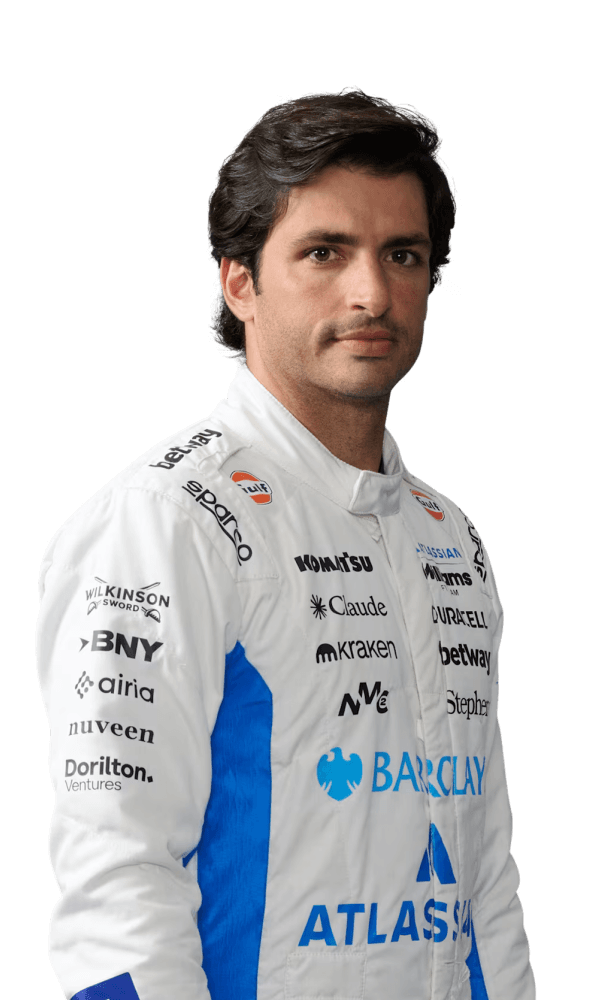
He joined Williams in 2025 alongside Alexander Albon.
The start of the partnership required him to adapt to a new car and a different way of working within the team. Strong results followed in the second half of the season, however. At the Azerbaijan Grand Prix, Sainz qualified second and finished third, earning Williams its first podium since 2021.
He added another third place in Qatar. The two podiums helped Williams secure fifth in the constructors’ championship, the team’s best result for several years.
The partnership with Sainz gradually developed from a short-term move into a longer-term project. The Spanish driver became a central figure in Williams’ efforts to re-establish itself as a regular contender at the front of the field.
His father’s influence and connection to rallying
Although Sainz chose circuit racing, rallying remained part of his life.
He has a close relationship with his father and has repeatedly spoken about drawing on the two-time world champion’s experience, particularly when it comes to his approach to the sport, preparation and handling pressure.
Sainz has also tried rally driving on several occasions. He has driven a course car at the Monte Carlo Rally, for example, and has also taken part in other outings alongside his father. He has said that driving on lower-grip surfaces helps him develop his feel for a car.
The family story also came together symbolically during Sainz’s time at Ferrari, when father and son were given the opportunity to drive Scuderia single-seaters together at Fiorano.
Life outside the cockpit
Away from race weekends, Sainz remains a keen sportsman.
Cycling, running and swimming have long been among his favourite activities, and he also uses them as part of his fitness training. In his spare time, he plays golf and football. Football is one of the sports he has followed and played since childhood.
His family and friends in Spain are also very important to him. In interviews, he has repeatedly described trips home, shared meals and time with loved ones as a way to reconnect with everyday life during the intensity of a Formula 1 season.
Sainz is also associated with the nickname “Smooth Operator”. It originated from the song by British-Nigerian singer Sade, which he would sing over the team radio after strong results. What began as a spontaneous moment gradually became one of his most recognisable trademarks among fans.
Another nickname is “Chili”, used by those close to him.
A career built on steady progress
Sainz’s career did not begin with an immediate move into a dominant team. From his debut at Toro Rosso, he progressed through Renault and McLaren before getting his opportunity at Ferrari and later taking on a role in Williams’ continued rebuilding.
Each of these chapters served a different purpose. Toro Rosso gave him his entry into Formula 1, Renault marked his first step outside the Red Bull system, and McLaren gave him the opportunity to establish himself as a team leader. At Ferrari, he became a grand prix winner for the first time, while at Williams he embraced the challenge of helping develop a historic team over the longer term.
His story is therefore more than simply the continuation of a famous motorsport name. From his first kart races in Spain, through the Formula Renault 3.5 title to victories in Formula 1, Carlos Sainz has forged a career of his own — not on the gravel where his father made his name, but on the circuits of motorsport’s highest category.
Teams raced for
Teams and race seasons recorded in our results archive (2015–2026).