

Overview
Current championship position
- Position
- 17
- Points
- 7
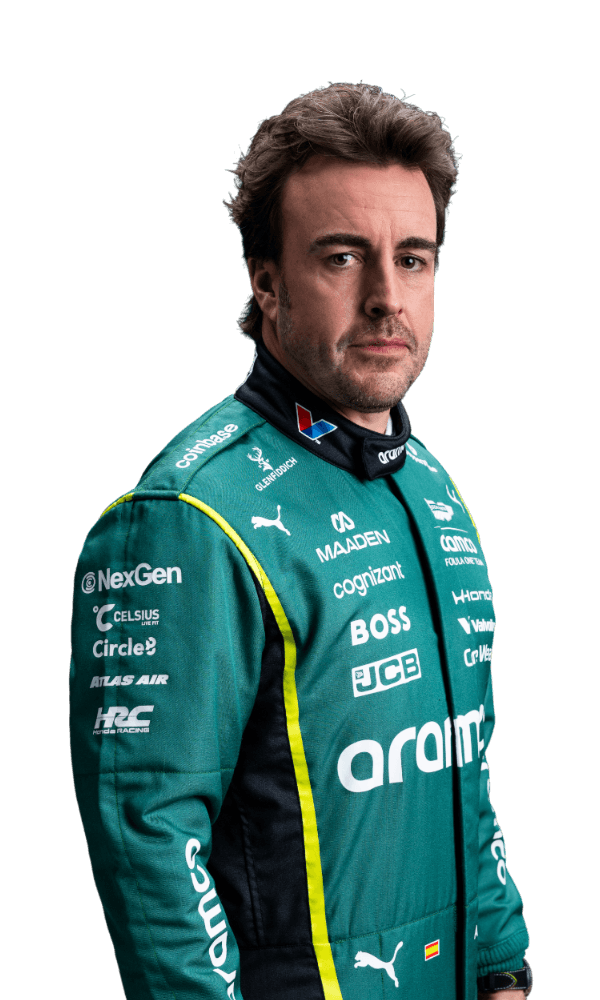
Driver biography: Fernando Alonso
Fernando Alonso began racing before most children can grasp the concept of the racing line, and even after decades behind the wheel, he has never stopped seeking new motorsport challenges. A two-time Formula 1 world champion, two-time Le Mans 24 Hours winner, world endurance champion and Daytona 24 Hours winner, he is one of those drivers whose career cannot be measured by results in a single championship.
Fernando Alonso Díaz was born on 29 July 1981 in Oviedo, northern Spain. He was introduced to motorsport by his father Luis, an amateur kart racer. Luis originally built a small kart for Fernando's older sister Lorena, but she showed little interest in driving it. The kart instead ended up in her younger brother's hands, beginning a journey that would eventually take him to the pinnacle of world motorsport.
From karting to one of Europe's brightest talents
Alonso began competing as a child, and it quickly became clear that this was more than a family hobby. His father also served as his mechanic in those early years, and the family had to build his career on a limited budget. Further opportunities therefore depended largely on results that could secure backing from sponsors and teams.
He went on to achieve considerable success in karting at both national and international level. One of his most significant achievements was the junior world title in 1996. While still a teenager, he had established himself as one of the leading European talents of his generation.
The move from karting to single-seaters came in 1999. Alonso entered Euro Open by Nissan and won the title in his very first season racing cars. His progress was unusually rapid: just one year in junior single-seaters was followed by International Formula 3000, then the final rung on the ladder to Formula 1.
He finished fourth in the F3000 championship in 2000. He attracted particular attention at the season finale at Spa-Francorchamps, where he took pole position, set the fastest lap and won. He was already testing a Minardi F1 car, and his performances accelerated his progress towards Formula 1.
A Minardi debut and a year of learning at Renault
In 2001, Alonso became a Minardi driver at the age of 19. The Italian team was then among the weakest on the grid in both technical and financial terms, leaving points almost out of reach. Alonso nevertheless impressed in qualifying and races, regularly extracting more from the car than its potential suggested was possible.
On his debut at the Australian Grand Prix, he outqualified his team-mate and moved up from his grid position to finish 12th. The results did little for his statistics, but his performances convinced Renault's management that he had a place in their future plans.
He spent the 2002 season as Renault's test driver. It was an important year for his career. Alonso covered extensive mileage, worked with the engineers and prepared to return to a race seat with a team whose ambitions were considerably higher than Minardi's.
In 2003, he got his chance.
And he seized it immediately.
At the Malaysian Grand Prix, he became the youngest pole-sitter in Formula 1 history at the time. He then claimed his first victory in Hungary, breaking another age record in the process. Renault had firmly established a driver around whom it could build its title ambitions.
Two titles and the end of Schumacher's reign
After a 2004 season in which Renault failed to repeat its previous victories, a major step forward followed. The R25 was among the best cars on the grid in 2005, and Alonso was ready to exploit its potential.
His main rival was McLaren's Kimi Räikkönen. Alonso relied on a combination of speed, consistency and Renault's reliability. He won seven grands prix during the season and secured his first world title at the Brazilian Grand Prix.
He was 24, making him the youngest world champion in Formula 1 history at the time.
His triumph also carried symbolic significance. Michael Schumacher had won the previous five titles with Ferrari, and Alonso was the first driver of a new generation to end that dominant run.
A year later, he successfully defended his crown. The 2006 season brought a head-to-head contest between Alonso and Schumacher's Ferrari. The fight continued almost to the end of the campaign, but the Spaniard ultimately secured his second consecutive title. Renault also retained the constructors' championship.
At 25, Alonso was a two-time world champion and one of Formula 1's leading figures.
An explosive year at McLaren
He moved to McLaren ahead of the 2007 season. He was expected to be the central figure in a team looking to return to the top, but his new team-mate was rookie Lewis Hamilton.
The seemingly clear hierarchy unravelled very quickly. Hamilton was competitive almost from the opening race, and an intense on-track rivalry developed between the two drivers. The tension gradually extended to Alonso's increasingly complicated relationship with McLaren's management.
The championship reached a dramatic conclusion. Hamilton and Alonso scored the same number of points, but Hamilton finished second on countback, with Alonso third. Both were just one point behind world champion Kimi Räikkönen.
Alonso's time at McLaren ended after just one season.
He therefore returned to Renault for 2008 and 2009. The team was no longer at the level of its championship-winning seasons, but Alonso still managed to win two grands prix in 2008. His second spell with Renault also served as a bridge to the next major chapter of his career.
Ferrari and two titles lost at the final race
In 2010, Alonso became a Ferrari driver.
The partnership between the two-time world champion and Formula 1's most famous team delivered immediate results. He won the Bahrain Grand Prix on his first start for Ferrari. He added four more victories during the season and arrived at the final round in Abu Dhabi as championship leader.
But the title eluded him. The way the race unfolded strategically left him stuck behind Vitaly Petrov's Renault, and Alonso finished seventh. Sebastian Vettel won the race and became world champion by four points.
Another major challenge came in 2012.
Ferrari did not begin the season with one of the most technically convincing cars on the grid, but Alonso capitalised on almost every opportunity. He won in Malaysia, Valencia and Germany, while regular podium finishes kept him in title contention until the final race.
Once again, the championship was decided in Brazil. Alonso finished second and Vettel sixth, giving the German the title by just three points.
Alonso again finished runner-up in the championship the following season. At the 2013 Spanish Grand Prix, he also claimed his 32nd Formula 1 victory. That number remained a significant career milestone in the years that followed.
It gradually became clear, however, that Ferrari could not consistently challenge the dominant Red Bull team and, later, Mercedes. After the 2014 season, Alonso decided to leave.
A return to McLaren and difficult years with Honda
From 2015, he raced for McLaren again, just as the team renewed its partnership with Honda. The project aimed to recapture the success of their earlier alliance, but its opening phase was beset by serious power unit performance and reliability problems.
Alonso went from fighting for titles to racing in the lower half of the field. His frustration at the lack of performance was epitomised by his famous “GP2 engine” radio message during the 2015 Japanese Grand Prix.
McLaren gradually improved, but not enough to return to the front. This period nevertheless brought a fundamental change in Alonso's direction. He began taking an increasingly keen interest in racing outside Formula 1.
Indianapolis and the Triple Crown dream
In 2017, he skipped the Monaco Grand Prix to compete in the Indianapolis 500.
He had virtually no previous experience of oval racing, yet qualified on the second row on his debut. He ran among the leaders during the race and challenged at the front at various stages. An engine failure eventually ended his race.
His Indianapolis entry was part of a bigger ambition: an attempt to complete motorsport's unofficial Triple Crown. Its three elements are traditionally considered to be the Monaco Grand Prix, the Indianapolis 500 and the Le Mans 24 Hours.
Alonso had already won Monaco in 2006 and 2007. That left Indianapolis and Le Mans.
He ticked off one of those very quickly.
Le Mans, Daytona and a world endurance title
In the 2018/2019 season, he combined his Formula 1 commitments with Toyota's FIA World Endurance Championship programme. He shared a Toyota TS050 Hybrid prototype with Sébastien Buemi and Kazuki Nakajima.
They won the six-hour race at Spa-Francorchamps on his first start with Toyota.
The 2018 Le Mans 24 Hours followed. After numerous unsuccessful attempts, Toyota had a clear objective: the first overall victory in the marque's history. The No. 8 crew delivered, and Alonso won Le Mans at his first attempt.
He repeated the victory a year later.
Their results across the WEC “super season” also secured the world endurance title for Alonso, Buemi and Nakajima. Alonso had become an FIA world champion in another discipline outside Formula 1.
In the meantime, he added another major American success. In January 2019, he contested the Daytona 24 Hours with Wayne Taylor Racing. His crew won a race heavily affected by rain.
In a short space of time, Alonso had won three editions of some of endurance racing's most famous events: Le Mans twice and Daytona once.
Leaving F1 did not mean the end of racing
After the 2018 season, Alonso left the regular Formula 1 grid. This was not, however, a conventional retirement from racing.
He continued in endurance racing, prepared further attempts at the Indianapolis 500 and began exploring an entirely different discipline: cross-country rallying.
He completed an extensive testing and preparation programme with Toyota, culminating in an entry in the 2020 Dakar Rally. His navigator was five-time Dakar motorcycle winner Marc Coma.
For a driver brought up on karting and circuit racing in single-seaters, it was a radical change. He had to learn to drive through dunes, over rocky terrain and using his co-driver's navigation.
He finished the Dakar 13th overall. On some stages he was among the fastest drivers, setting the second-fastest time on stage eight.
The experience only underlined the unusual breadth of his motorsport CV.
A return to Formula 1
After a two-year break, Alonso returned to Formula 1 in 2021. He joined Alpine, the successor to the works Renault team with which he had won both his world titles.
He was back on the podium in the first season of his comeback, finishing third at the Qatar Grand Prix. It showed that, even after years away from regular F1 competition, he had lost none of his ability to compete at a high level.
He spent two seasons with Alpine. Ahead of the 2023 campaign, he made another significant move, joining Aston Martin.
The partnership began successfully. Alonso finished on the podium at the season opener in Bahrain and collected eight podium finishes over the year. Although Aston Martin did not give him a car capable of regularly fighting for victories, his performances once again underlined his remarkable longevity.
He also went on to set new Formula 1 records for race starts and grands prix contested. He became the first driver to reach 400 Grand Prix appearances and continues to extend a career that began in the Michael Schumacher era.
The driver who wanted to be more than an F1 driver
One of the defining features of Alonso's career is his willingness to step outside an environment he knew inside out.
After two Formula 1 world titles, he had nothing left to prove as a successful single-seater driver. Yet he started learning from scratch about oval racing for Indianapolis, endurance prototypes for Le Mans and, eventually, dunes and cross-country rally navigation ahead of the Dakar.
That is what sets his motorsport CV apart from the careers of most modern F1 champions.
Alongside his two Formula 1 world titles, he has 32 Grand Prix victories, two overall Le Mans 24 Hours wins, an FIA WEC world title and a Daytona 24 Hours victory. He has also contested the Indianapolis 500 and completed the Dakar.
The complete Triple Crown still eludes him, as he has yet to win the Indianapolis 500 despite several attempts.
Life beyond grands prix
Motorsport has remained a significant part of Alonso's life away from professional racing.
The Museo y Circuito Fernando Alonso was established in his native Asturias, a complex housing a museum dedicated to his career and a karting circuit. The foundation associated with the project also runs road safety education programmes and supports young kart racers.
Alonso was also personally involved in creating a karting programme for children. His return to karting carries a natural symbolism: it was where his own journey began.
Among sports outside motorsport, cycling has long been a particular passion. He has also spoken publicly about his interest in football, basketball and tennis. Physical conditioning and endurance sports have remained a natural part of his training, including in the later years of his professional career.
A career that defies a simple definition
Fernando Alonso has experienced periods in Formula 1 when almost everything fell into place, as well as years when his ability far exceeded the potential of the machinery available to him.
He won two titles with Renault and ended Schumacher's championship streak. With McLaren in 2007, he fought for the title until the final round. At Ferrari, two more title opportunities slipped away only at the final races of the 2010 and 2012 seasons. He later endured the difficult McLaren-Honda project, stepped away from Formula 1 for a time and subsequently returned.
In the meantime, however, his career had grown beyond the boundaries of a single championship.
He won Le Mans, Daytona and a world endurance title. He tried Indianapolis. He completed the Dakar. And after all that, he climbed back into a Formula 1 car and returned to the podium.
That combination of longevity, success across different disciplines and a willingness to keep starting afresh in unfamiliar surroundings lies at the heart of Alonso's motorsport story. Whenever his final season comes, two decades at the highest level already represent just one part of a career that began in a small kart in Asturias and expanded to the world's most famous circuits, ovals, endurance venues and deserts.
Teams raced for
Teams and race seasons recorded in our results archive (2001–2026).