

- Date of Birth
- Place of Birth
- Emmerich am Rhein, Germany
Overview
Current championship position
- Position
- 14
- Points
- 13
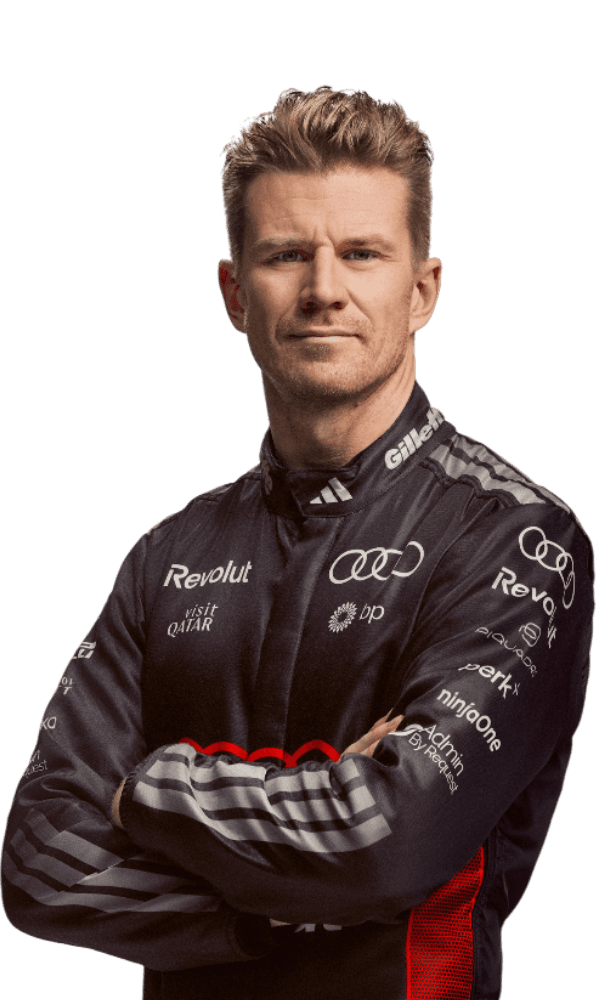
Driver biography: Nico Hülkenberg
Some racing careers can be told through a succession of trophies. Nico Hülkenberg’s story is more interesting: it began with a dominant rise through the junior categories, brought a Formula 1 pole position and an outright victory at the Le Mans 24 Hours, and, after years of waiting, finally delivered a long-awaited podium at the pinnacle of the sport. Along the way, he lost a permanent place on the grid several times and always managed to find his way back.
Over the years, the German built a reputation as a quick, technically accomplished driver, valued by teams above all for his consistency, experience and ability to deliver even when conditions were less than ideal. His career is also a reminder that a driver’s achievements are not defined solely by the number of Formula 1 victories.
From karting to single-seaters
Nico Hülkenberg was born in 1987 in Emmerich, Germany. He took up karting as a child and very quickly began producing results that pointed to considerable talent. In 2002, he became German junior karting champion, before winning the German championship a year later.
The move to single-seaters did not slow his progress. He won the German Formula BMW championship in 2005, and success followed on the international stage. Representing Germany in A1 Grand Prix, he made a major contribution to the team’s title in the 2006/2007 season. He took nine victories that campaign, proving he could handle not only quick qualifying laps but also the pressure of racing at a higher level.
The Formula 3 Euro Series came next. After a first year spent gaining experience, he won the title in 2008. By then, he was also part of Williams’ programme and was getting his first opportunities in a Formula 1 car.
The final major stop before reaching the top flight was the GP2 Series, now Formula 2. Hülkenberg joined the championship in 2009 with ART Grand Prix and won the title in his rookie season. Five victories and the championship definitively dispelled any doubts about whether he was ready for Formula 1.
His junior record was exceptionally convincing by that stage: he had won titles in Formula BMW, A1 Grand Prix, the Formula 3 Euro Series and GP2.
Williams and a sensational pole position
He entered Formula 1 in 2010 as a Williams race driver. His team-mate was the vastly experienced Rubens Barrichello, immediately giving the rookie a demanding benchmark.
Hülkenberg scored points in only his third Grand Prix, but the defining moment of his debut season came towards its end. In qualifying for the Brazilian Grand Prix, he made the most of changing conditions at Interlagos to claim a sensational pole position. It was not the product of a dominant car: Williams was not among the teams regularly fighting for first place at the time. That made his performance all the more striking.
Even pole position was not enough to save his seat, however. Williams changed its driver line-up ahead of the following season, leaving Hülkenberg without a race drive.
Rather than leave Formula 1, he accepted a test and reserve driver role at Force India for 2011. It was a step backwards in terms of racing opportunities, but also a way to remain directly involved in the championship.
Force India and a first major chance of victory
His patience paid off. In 2012, Hülkenberg returned to the grid as a full-time Force India driver.
One of the biggest opportunities of his career came at the Brazilian Grand Prix. In challenging conditions, he ran at the front and even led the race for a time. But contact during a battle with Lewis Hamilton ended his chance of a result that could have transformed his Formula 1 record.
Brazil 2012 would become one of several weekends on which Hülkenberg came close to the podium without actually reaching it.
He moved to Sauber for the 2013 season. Despite a difficult start to the year, he was able to fight regularly for points, particularly in its second half. After just one season, however, he returned to Force India, where he spent the next three years.
That period cemented his status as one of the midfield’s respected drivers. Hülkenberg regularly scored points and made the most of the opportunities his machinery offered, but he never had a car capable of consistently fighting for victories.
Le Mans: success beyond Formula 1
Ironically, the greatest triumph of his career up to that point did not come in Formula 1.
Porsche recruited Hülkenberg for its programme in endurance racing’s top category. During the 2015 season, he therefore combined his Force India commitments with driving the technologically advanced Porsche 919 Hybrid prototype.
He contested the Le Mans 24 Hours alongside Nick Tandy and Earl Bamber. The crew of the number 19 car completed 395 laps over the course of the day to take outright victory.
Hülkenberg had won one of the world’s most prestigious motor races at his first attempt at Le Mans. He did so while still an active Formula 1 driver, something unusual in the modern era.
The success carried particular significance for Porsche, too. It gave the manufacturer its first outright Le Mans victory since 1998 and marked the beginning of a run of further successes for the 919 Hybrid.
For Hülkenberg, Le Mans remained proof that his abilities extended beyond single-seaters. He has repeatedly named the victory among the most significant memories of his career.
The Renault works years
After spending much of his career with smaller teams, Hülkenberg accepted an offer from the Renault works outfit. From the 2017 season, he became part of a project seeking to gradually restore the French manufacturer to the front of Formula 1.
He spent three seasons at Renault. His highest finish in the drivers’ standings came in 2018, when he placed seventh. It was the best championship finish of his career.
Yet his unusual statistical curse continued. Hülkenberg could score points and regularly run in the top 10, but a podium remained elusive.
The 2019 German Grand Prix was a particularly notable missed opportunity. In a chaotic wet race at Hockenheim, he was fighting for a strong result before running off the track and hitting the barriers. A home podium, which had looked a genuine possibility at one stage, once again failed to materialise.
Renault did not renew his contract at the end of the 2019 season, leaving Hülkenberg without a permanent place on the grid for the second time in his career.
From the sofa straight into Formula 1
What followed became another defining chapter of his career.
In 2020, he received an unexpected opportunity from Racing Point. When Sergio Pérez was unable to race after testing positive for coronavirus, the team called up Hülkenberg as a substitute. Without the usual preparation, he had to readjust to a Formula 1 car at very short notice.
The circumstances were even more extreme for another stand-in appearance at the Nürburgring. Hülkenberg had not been due to race that weekend, but received a last-minute call-up after Lance Stroll fell ill. He went into qualifying with virtually no preparation, then climbed from last on the grid to eighth in the race.
He later described the weekend as one of the moments in his career of which he was particularly proud.
After Racing Point became Aston Martin, he remained associated with the team as its reserve driver. In 2022, he deputised for Sebastian Vettel on two further occasions.
Although Hülkenberg spent three seasons without a regular race seat, he never disappeared from Formula 1 entirely.
‘Hülkenback’: a full-time return with Haas
Ahead of the 2023 season came a decision that was unusual in modern Formula 1. Rather than choosing another young driver, Haas turned to the then 35-year-old Hülkenberg and brought him back onto the grid full-time.
After three years without a full season, he proved he had lost none of his speed. He was particularly impressive in qualifying. Haas struggled with race pace and tyre wear during his first year, meaning strong grid positions could not always be converted into points, but Hülkenberg’s comeback convinced the team of his value.
He remained at Haas for the following season. His performances also caught the attention of a project preparing one of the biggest new entries into Formula 1.
Back to Hinwil and finally a podium
In 2025, Hülkenberg returned to the team based in Hinwil, Switzerland, for which he had already raced in 2013. This time, however, the partnership had wider significance. Sauber was preparing to become the Audi works team, and the experienced German had been chosen as one of the project’s key figures.
It was during this chapter that one of the longest waits in Formula 1 history came to an end.
Hülkenberg started the 2025 British Grand Prix down in 19th place. But changeable weather, strategic decisions and a faultless drive gradually moved him forwards. In the closing stages, he reached third place and held the position to the finish.
After 238 previous Formula 1 starts, he finally stood on the podium at his 239th attempt.
It was hard to imagine a more symbolic result. A driver whose name had been associated for years with the record for the most Grands Prix without a podium closed that chapter in a race he had started almost at the very back of the field.
A new chapter with Audi
Sauber’s transformation into the Audi works team made Hülkenberg part of another significant chapter in his motorsport career. Audi had selected him well in advance as one of the drivers for its project, and he entered the new era alongside Gabriel Bortoleto.
For the German, it also brings together two long-running stories. Hülkenberg has spent most of his professional life in Formula 1, while Audi entered the championship with its own works programme after decades of success in other motorsport disciplines.
His role is no longer just about outright speed. Years at Williams, Force India, Sauber, Renault and Haas, as well as his time as a reserve driver, have given him experience of very different technical environments. His feedback and ability to help develop a car are particularly valuable qualities when building a new works project.
Nico away from the cockpit
Throughout his career, Hülkenberg has maintained a relatively down-to-earth public image. He has described himself as someone who can easily switch off and relax in his spare time, although the physical preparation required of a professional driver naturally occupies a significant part of his life.
His training has included running, gym work, tennis and cycling. He has also played tennis with fellow Formula 1 drivers, while bike rides have been among the shared activities of drivers living around Monaco. Among motorsport disciplines outside F1, he has named MotoGP as one he enjoys watching.
In interviews, he has also spoken openly about his interest in cars and watches. In contrast to the tightly controlled routine of a professional athlete, he has made no secret of his weakness for chocolate and burgers. His dog Zeus is also among his publicly known companions.
Away from the helmet, Hülkenberg generally comes across as calm and pragmatic. Asked in one interview to describe himself in three words, he chose determined, straightforward and fun. It is a description that also captures his professional career rather well.
A career built on persistence
Hülkenberg’s career is an unusual one in motorsport. Before reaching Formula 1, he won almost everywhere he went. He became champion in Formula BMW, A1 Grand Prix, the Formula 3 Euro Series and GP2. In Formula 1, he claimed pole position in his rookie season. He then won the Le Mans 24 Hours while still an active F1 driver.
Yet for many years, his career was marked by the absence of a result considered one of Formula 1’s basic measures of success: a podium finish.
His story did not end when he first lost his Williams seat, however. Nor did it end after his departure from Renault, or during his years as a reserve driver. He returned with Haas, later rejoined Sauber, became part of Audi’s works project and eventually secured the podium that had eluded him for so long.
That is why his career is defined less by any single result than by his ability to remain relevant across several generations of Formula 1. Nico Hülkenberg’s journey has taken him from karting through a dominant junior career, pole position and victory at Le Mans to a return as a regular on the world championship grid. And in a sport where a single season can determine a driver’s future, perhaps his most striking achievement is how often he has managed to earn another opportunity — and make the most of it.
Teams raced for
Teams and race seasons recorded in our results archive (2010–2026).